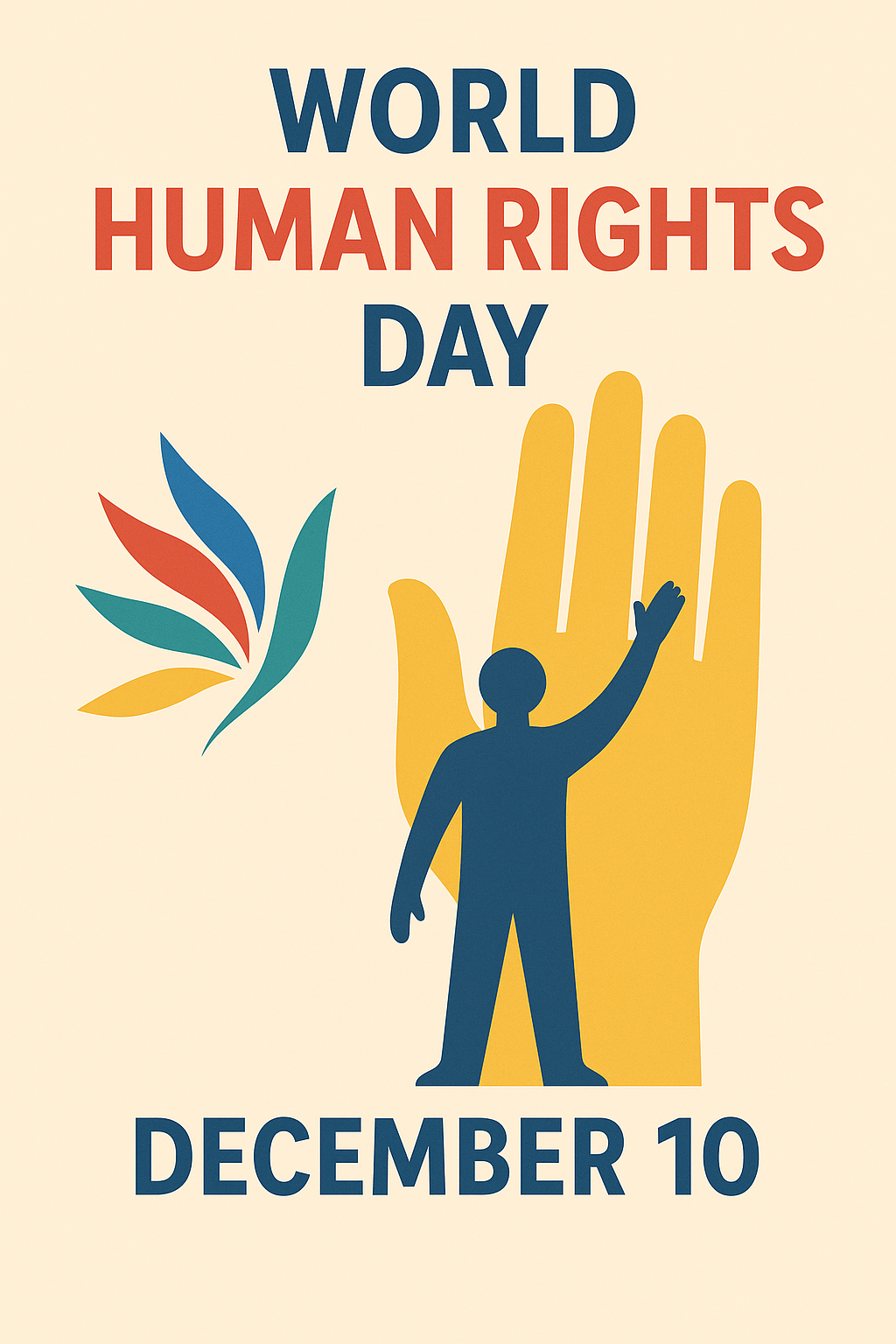
December 10 is Human Rights Day. On this occasion, we pay tribute to all individuals and organizations dedicated to advancing human rights.By Bi Yantao
I. Concept and Basic Connotations of Human Rights
On 10 December 1948, the UN General Assembly adopted the Universal Declaration of Human Rights (UDHR), marking the first time the international community collectively affirmed the principle that “all human beings are born free and equal in dignity and rights.” Since then, 10 December has been recognized as Human Rights Day, offering states an annual moment for reflection and dialogue on human rights.
In international law, “human rights” refer to the fundamental rights inherent to every individual by virtue of being human. These rights are universal, inalienable, interdependent, and indivisible. The core instruments of the international human rights system include the UDHR, the International Covenant on Civil and Political Rights (ICCPR), and the International Covenant on Economic, Social and Cultural Rights (ICESCR).
Human rights are often categorized into three groups:
- Civil and political rights: right to life, personal liberty, freedom of expression, voting rights, freedom of religion, etc.
- Economic, social and cultural rights: right to education, the right to work, medical care, social security, and an adequate standard of living.
- Collective and developmental rights: environmental rights, the right to development, the right to peace, and others.
Importantly, human rights are historically constructed. While states act as formal rule-makers, public discourse, civil society, social movements, and academic debate continuously drive their evolution. The shift from first-generation rights (civil and political) to second-generation rights (economic, social, cultural), and then to third-generation rights (developmental and environmental), reflects the ongoing expansion of human rights content.
II. China’s Human Rights Concepts and Practices
“Human rights in China” is not a single, fixed notion but a multi-layered and evolving ecosystem shaped by state policy, social demands, and academic debate.
- State perspective: Priority on the rights to subsistence and development
Chinese official discourse emphasizes:
- the primacy of the rights to subsistence and development;
- the state’s central responsibility in securing these rights through economic growth, poverty alleviation, education, and healthcare;
- the view that social stability is a precondition for the realization of all rights.
This approach is rooted in historical realities, where poverty and social instability long constituted major challenges.
2. Societal perspective: Diverse voices and emerging rights claims
Within China, a variety of human rights demands shape public debate:
- Procedural justice and judicial integrity: public attention to transparency, anti-corruption, and constraints on public power;
- Expression and participation: expectations for access to information and opportunities for public input in policy and environmental governance;
- Emerging social rights: environmental rights, health rights, digital rights, and privacy receive increasing attention.
These bottom-up demands reflect autonomous societal engagement with human rights beyond official narratives.
3. Academic and policy communities as intermediaries
Chinese scholars and think tanks offer integrative perspectives:
- strengthening institutionalization and justiciability of rights;
- advocating a role for social organizations in rights protection;
- exploring the interplay between traditional culture and modern human rights norms.
Thus, China’s human rights discourse comprises state policy, societal expectations, and academic reflection.
III. Western Human Rights Concepts and Practices
Western—especially U.S.—human rights thinking centers on individual liberty and political rights:
- emphasis on protecting individuals from government interference;
- reliance on political institutions, constitutionalism, and judicial independence;
- the key role of civil society and the media in rights oversight.
Human rights practice in the West is grounded in legal mechanisms, checks and balances, and civic participation.
IV. Key Differences Between China and the Western World
The divergences can be understood along several dimensions:
- Conceptual foundations: the U.S. prioritizes individual liberty; China stresses development and collective well-being.
- Rights prioritization: Western systems foreground civil and political rights; China, at its development stage, emphasizes subsistence and socioeconomic rights.
- Implementation pathways: the U.S. relies on legal and judicial mechanisms plus civic oversight; China focuses on state-led policy arrangements.
- Role of society: China’s societal demands increasingly shape human rights discourse, while Western systems institutionalize civic oversight.
These differences reflect distinct histories, social structures, and cultural traditions rather than simple value judgments.
V. Conclusion
Human rights are both universal values and evolving norms. In China, human rights encompass not only the state’s emphasis on subsistence and development but also diverse societal demands for judicial justice, expression, environmental protection, and digital rights.
The divergence between China and the West reflects differing institutional logics and developmental contexts. Recognizing this diversity and focusing on shared concerns is essential for constructive dialogue. Only through such engagement can human rights become a point of convergence for global public interests rather than an extension of geopolitical competition.
Bi Yantao is Editor-in-Chief of Communication Without Borders (CWB) and a professor of communication studies.