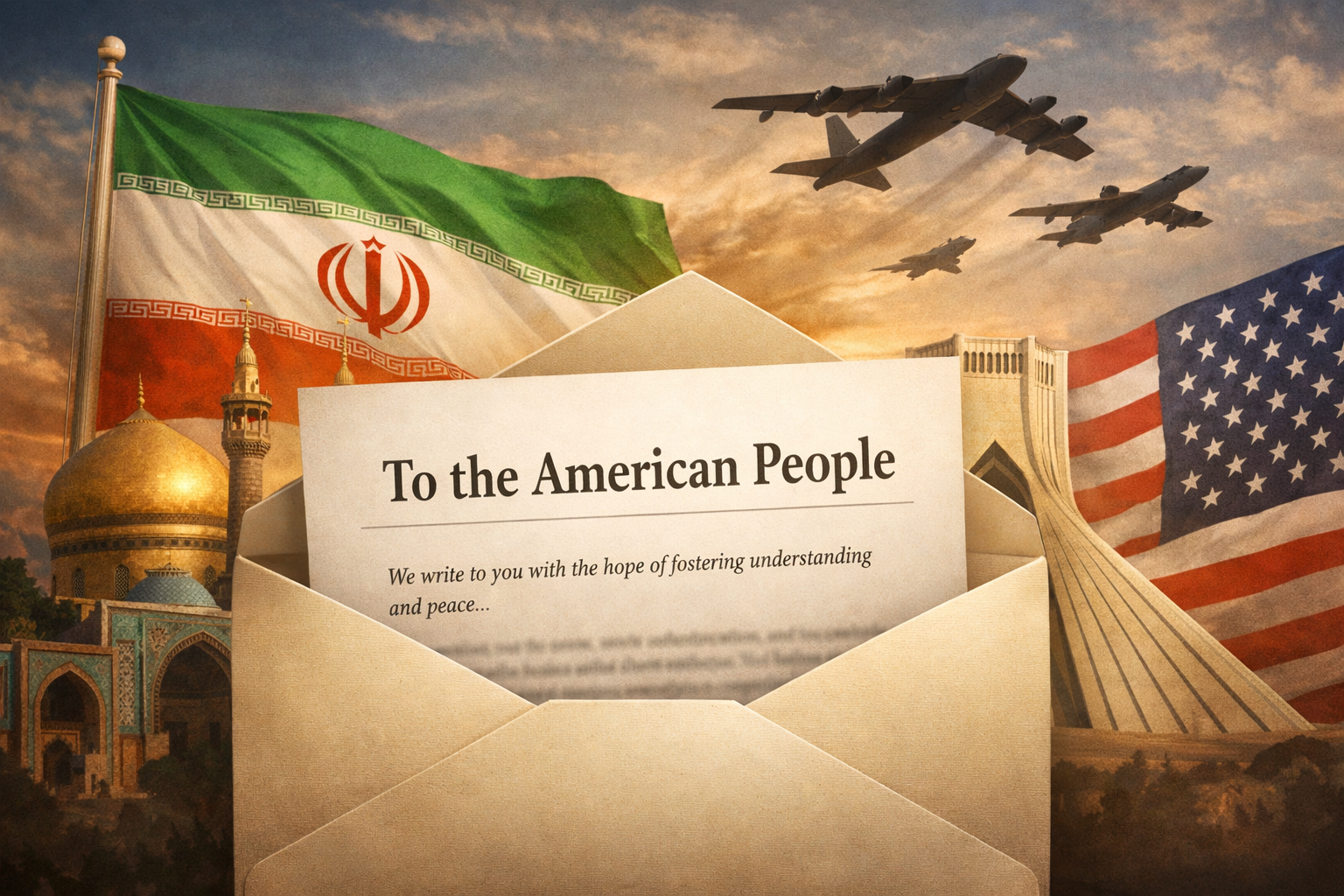
伊朗发布这封公开信,是一次典型的公共外交实践。
文/毕研韬
伊朗总统易卜拉欣·莱西于2026年4月1日发布了一份致美国人民的公开信。该信件的官方原文是波斯语,网络上流传的英文版本均为媒体翻译文本,并非官方英文版本。中国部分自媒体误传“伊朗总统以波斯语和英文双语发布”,与事实不符。
一、公开信的传播策略
这封公开信的传播策略可以从受众定位、信息呈现、叙事结构与媒介选择几个维度进行分析。
1.受众定位
信件明确面向三个层次的受众:
- 直接受众:美国公众。公开信开篇即称“致美利坚合众国人民”,强调读者是“在失真信息洪流中仍追求真相的人”,试图与普通美国人建立心理共鸣,区分“美国政府行为”与“美国民众”。
- 间接受众:国际舆论,包括西方媒体及政策制定者。通过英文媒体转载的文本,信件的论述,数据,历史回顾呈现伊朗理性、合法、防御性形象,以影响国际社会对冲突的认知。
- 内部受众:伊朗国内及伊朗海外公民。通过公开信的形式向国际社会展现理性立场,也起到强化国内民族认同与正当性诉求的作用。
这一策略遵循国际传播中的双向定位原则:既面向外部争取理解,也面向内部稳固舆论。
2.信息呈现策略
- 叙事化历史重构:信件通过1953年政变、两伊战争、制裁历史等事件构建“伊朗被动防御、从不侵略”的历史叙事。这是典型的历史合法性话语(Historical Legitimacy Narrative),意在强化道义权威。
- 区分政府与民众:多次强调“伊朗人民与政府不同”“美国政府与美国民众不同”,属于“认知分层策略”,降低直接对抗情绪,增加目标受众的认同可能。
- 情绪共鸣与理性结合:通过列举战争、制裁对民生影响(儿童、医疗、教育),唤起同情,同时以发展成就、科技教育数据展示理性证据。这是典型的理性-情绪双重说服策略。
- 直接质问与反问:例如“美国人民的利益究竟在哪?”用反问引发受众反思政府行为,增强参与感和认知参与度。
3. 叙事结构与传播逻辑
信件结构呈现“身份—历史—现实—反问—倡议”的逻辑:
- 强化伊朗文明与和平形象(身份认同)
- 回顾被攻击历史与不侵略行为(历史合法性)
- 说明制裁与军事压力下的防御行为(事实证据)
- 质疑美国政府行动、呼吁民众思考(认知反转)
- 提出“选择对话而非对抗”的未来倡议(行动倡导)
这一结构体现典型的公共外交逻辑:从价值认同引入事实证据,再触发认知反思,最后引导舆论对未来选择产生共鸣。
4. 媒介与语言策略
- 英文媒体转载:英文文本主要通过权威新闻机构(如Press TV、DAWN、Time等)翻译转发。虽然这些文本不是官方英文版本,但在国际舆论中发挥类似传播效果。
- 官方权威感:信件由总统署名,采用正式书信格式,开头引用宗教元素“奉仁慈、慈悲的真主之名”,强化道德与文化权威。
- 多渠道扩散:政府媒体、新闻媒体接力发布,形成跨媒介覆盖。
三、传播效果评估
- 潜在正面效果
- 在国际公众舆论中,呈现了伊朗和平、理性、防御性的国家形象。
- 对美国民众形成“政府行为与人民不同”的认知框架,有可能降低敌意认知。
- 历史与数据引用增强说服力,使信息更具权威性与可信度。
2.潜在局限与风险
- 受众选择偏差:美国主流舆论长期受政策与媒体框架影响,信件可能影响对伊朗持开放或中立态度的群体,而对深度反感伊朗的群体效果有限。
- 信息真实性争议:信中历史与数据虽可查证,但信件呈现的伊朗官方叙事可能被怀疑具有偏向性,对敌对伊朗的美国政策制定者影响有限。
- 传播延迟:由于依赖媒体转载,信息扩散速度可能低于即时社交媒体动态,限制舆论形成的实时性。
毕研韬系海南大学国际传播与艺术学院教授、察哈尔学会高级研究员。本文仅代表作者个人观点,不代表所在机构之立场。附件1:英文汇总版(依据多家权威报道汇总重构)
In the name of God, the Compassionate, the Merciful.
To the people of the United States of America, and to all those who, amid a flood of distortions and manufactured narratives, continue to seek the truth and aspire to a better life:
Iran—by this very name, character, and identity—is one of the oldest continuous civilizations in human history. Despite its historical and geographical advantages at various times, Iran has never, in its modern history, chosen the path of aggression, expansion, colonialism, or domination. Even after enduring occupation, invasion, and sustained pressure from global powers—and despite possessing military superiority over many of its neighbors—Iran has never initiated a war. Yet it has resolutely and bravely repelled those who have attacked it.
The Iranian people harbor no enmity toward other nations, including the people of America, Europe, or neighboring countries. Even in the face of repeated foreign interventions and pressures throughout their proud history, Iranians have consistently drawn a clear distinction between governments and the peoples they govern. This is a deeply rooted principle in Iranian culture and collective consciousness—not a temporary political stance.
For this reason, portraying Iran as a threat is neither consistent with historical reality nor with present-day observable facts. Such a perception is the product of political and economic whims of the powerful—the need to manufacture an enemy in order to justify pressure, maintain military dominance, sustain the arms industry, and control strategic markets. In such an environment, if a threat does not exist, it is invented.
Within this same framework, the United States has concentrated the largest number of its forces, bases, and military capabilities around Iran—a country that, at least since the founding of the United States, has never initiated a war. Recent American aggressions launched from these very bases have demonstrated how threatening such a military presence truly is. Naturally, no country confronted with such conditions would forgo strengthening its defensive capabilities. What Iran has done—and continues to do—is a measured response grounded in legitimate self‑defense, and by no means an initiation of war or aggression.
Relations between Iran and the United States were not originally hostile, and early interactions between the Iranian and American people were not marred with hostility or tension. The turning point, however, was the 1953 coup d’état—an illegal American intervention aimed at preventing the nationalization of Iran’s own resources. That coup disrupted Iran’s democratic process, reinstated dictatorship, and sowed deep distrust among Iranians toward U.S. policies. This distrust deepened further with America’s support for the Shah’s regime, its backing of Saddam Hussein during the imposed war of the 1980s, the imposition of the longest and most comprehensive sanctions in modern history, and ultimately, unprovoked military aggression—twice, in the midst of negotiations—against Iran.
Yet all these pressures have failed to weaken Iran. On the contrary, the country has grown stronger in many areas: literacy rates have tripled—from roughly 30% before the Islamic Revolution to over 90% today; higher education has expanded dramatically; significant advances have been achieved in modern technology; healthcare services have improved; and infrastructure has developed at a pace and scale incomparable to the past. These are measurable, observable realities that stand independent of fabricated narratives.
At the same time, the destructive and inhumane impact of sanctions, war, and aggression on the lives of the resilient Iranian people must not be underestimated. The continuation of military aggression and recent bombings profoundly affect people’s lives, attitudes, and perspectives. This reflects a fundamental human truth: when war inflicts irreparable harm on lives, homes, cities, and futures, people will not remain indifferent toward those responsible.
This raises a fundamental question: exactly which of the American people’s interests are truly being served by this war? Was there any objective threat from Iran to justify such behavior? Does the massacre of innocent children, the destruction of cancer‑treatment pharmaceutical facilities, or boasting about bombing a country “back to the stone ages” serve any purpose other than further damaging the United States’ global standing?
Iran pursued negotiations, reached an agreement, and fulfilled all its commitments. Is it not evident that Israel now aims to fight Iran to the last American soldier and the last American taxpayer dollar—shifting the burden of its delusions onto Iran, the region, and the United States itself in pursuit of illegitimate interests?
Is “America First” truly among the priorities of the U.S. government today? I invite you to look beyond the machinery of misinformation—an integral part of this aggression—and instead speak with those who have visited Iran. Observe the many accomplished Iranian immigrants—educated in Iran—who now teach and conduct research at the world’s most prestigious universities, or contribute to the most advanced technology firms in the West. Do these realities align with the distortions you are being told about Iran and its people?
Today, the world stands at a crossroads. Continuing along the path of confrontation is more costly and futile than ever before. The choice between confrontation and engagement is both real and consequential; its outcome will shape the future for generations to come. Throughout its millennia of proud history, Iran has outlasted many aggressors. All that remains of them are tarnished names in history, while Iran endures—resilient, dignified, and proud.
附件2:中文译文(依据英文版翻译,仅供参考)
奉仁慈、慈悲的真主之名。
致美利坚合众国人民,以及所有在失真与人为制造的叙事洪流中仍寻求真相、渴望更好生活的人们:
伊朗——这个名字、这个性格与这个身份代表着人类历史上最古老的连续文明之一。尽管在不同时期拥有历史和地理上的优势,伊朗在其现代历史中从未选择过侵略、扩张、殖民或统治他国的道路。即便在遭受占领、入侵及全球强权的持续施压之下——尽管在军事实力上曾胜过许多邻国——伊朗从未发起战争,但它坚定而勇敢地反击过那些攻击它的人。
伊朗人民对其他国家的人民,包括美国、欧洲或邻国的人民,并无敌意。即便在他们光荣的历史中面对反复的外部干涉与压力,伊朗人始终明确区分政府与被治理者之间的关系。这是伊朗文化与集体意识中根深蒂固的原则——不是暂时的政治立场。
因此,将伊朗描绘成威胁既不符合历史现实,也不符合当前可观察的事实。这种观念是权势者政治与经济意愿的产物——为寻找施压借口、维持军事优势、支撑军工产业和控制战略市场而需要炮制一个敌人。在这样的环境中,如果威胁不存在,它就被发明出来。
同一框架下,美国将其最多的军力、基地和军事能力集中在伊朗周边——一个至少自美国成立以来从未发起过战争的国家。从这些基地发动的近期美国侵略行为表明,这种军事存在本身才是真正的威胁。自然,任何面对这种条件的国家都不会放弃加强其防御能力。伊朗所做的也是如此——基于合法自卫的审慎回应,绝非战争或侵略的发起者。
伊朗与美国之间的关系最初并非敌对,伊朗人与美国人早期交流也不曾伴随对立或紧张。然而转折点是1953年的政变——美国旨在阻止伊朗资源国有化的非法干预。这次政变扰乱了伊朗的民主进程,恢复了独裁,并在伊朗人对美政策中播下深刻的不信任。这种不信任随着美国支持巴列维国王政权、在1980年代支持萨达姆·侯赛因以及施加历史上最长、最全面的制裁而不断加深,并在谈判期间两次对伊朗发动军事行动后进一步恶化。
所有这些压力并未削弱伊朗,相反,在许多领域伊朗变得更强大:从伊斯兰革命前约30%的识字率增长到今天超过90%;高等教育显著扩展;在现代技术、医疗服务和基础设施方面取得了重大进步。这些是可衡量、可观察的现实,与被炮制的叙事无关。
与此同时,制裁、战争和侵略对伊朗人民生活的破坏性和非人道影响不容低估。持续的军事侵略和近期轰炸深刻影响着人们的生活、态度和视角。这反映了一个基本的人类真理:当战争对生命、家园、城市和未来造成不可弥补的伤害时,人们不会对这些伤害的责任者无动于衷。
这提出了一个根本性问题:到底哪一部分美国人民的利益是真正通过这场战争得到维护的?为了证明这种行为合理,伊朗是否构成了任何客观的威胁?屠杀无辜儿童、摧毁癌症治疗药品设施、吹嘘要将一个国家“炸回石器时代”——除了进一步损害美国的全球声誉之外,还有其他目的么?
伊朗曾寻求谈判,达成协议,并履行了所有承诺。难道不明显吗?以色列如今的目标是让美国为其幻想付出代价:与伊朗战斗到最后一名美国士兵和最后一美元的纳税人资金,将其不合法的利益强加给伊朗、该地区和美国本身?
如今,“美国优先”真的是美国政府今天的优先事项吗?我邀请你超越信息操纵机器(这场侵略的组成部分)去与访问过伊朗的人交谈。观察那些在世界最负盛名大学任教或从事科研工作的伊朗移民,他们在西方最先进的技术公司做出贡献。这些现实是否与你被告知的关于伊朗及其人民的扭曲叙事一致? 今天,世界处于十字路口。继续沿对抗道路前进既昂贵又徒劳。对抗与接触之间的选择既真实又具有重大影响;其结果将决定未来几代人的走向。在其千年光荣历史中,伊朗经受住了许多侵略者的考验,而这些侵略者留给历史的只是玷污的名字,而伊朗依然坚韧、自尊、骄傲地存在。