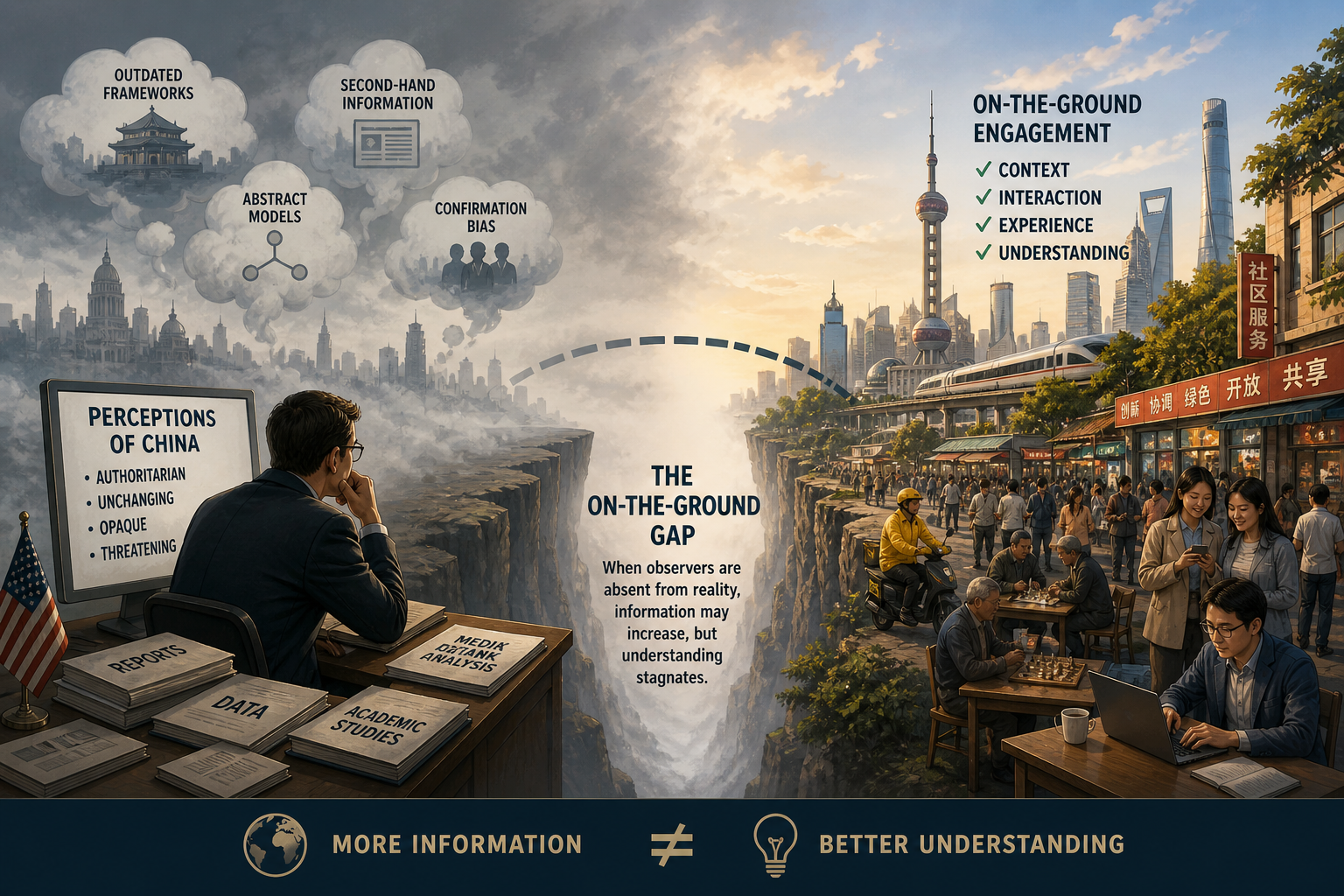
When observers are absent from China’s lived reality, more information may lead to more systematic misjudgment.
By Bi Yantao
Published May 4, 2026
I. A Cognitive Gap Revealed Over Dinner
A long-time friend recently returned from a five-month visit to the United States, where she had been staying with family. With a relatively flexible schedule and broad social exposure, she interacted with a range of communities. Reflecting on her experience, she highlighted a striking observation: certain segments of American society—including some Chinese diaspora groups—retain perceptions of China that are clearly outdated.
She cited a specific example: within one Christian community, understandings of China remain anchored in the early reform-era framework.
This observation directly resonates with my own recent assessments. In previous writings, I have noted recurring “structural misreadings” in U.S. think tank research on China. In a recent analysis, I argued that research by the China Media Project lacks an internal perspective. This conversation provided an experiential corroboration of that claim.
The question thus becomes more concrete: in an era of unprecedented information availability, why do perceptions of China remain lagged—or even distorted?
II. The Problem Is Not Information Scarcity
At first glance, this phenomenon is often attributed to insufficient information. However, this explanation does not hold.
Today, publicly available information about China—from macroeconomic data to policy documents, from media coverage to academic research—is more abundant and accessible than ever before. For trained analysts, the issue is rarely a lack of awareness of “what is happening.”
The real problem lies elsewhere: possessing large volumes of information does not equate to understanding how the system operates.
Much of the available information exists at the level of facts—describing what has occurred. Strategic judgment, however, depends on grasping the level of mechanisms and context: why changes occur, how systems function, and where they are heading. It is precisely at this level that systematic cognitive deviations begin to emerge.
III. The “On-the-Ground Gap”: A Foundational Variable
Based on both observation and experience, the issue can be reduced to a more fundamental variable: the absence of embedded, on-the-ground experience.
“On-the-ground” should not be understood merely as physical presence. Rather, it refers to sustained, embedded engagement with the actual functioning of a society. This includes continuous interaction with actors across different levels, contextual observation of institutional processes, and an embodied sense of social rhythms and behavioral expectations.
When this dimension is absent, cognitive systems inevitably shift toward substitute mechanisms: interpreting new phenomena through pre-existing frameworks, assembling reality from second-hand information, and filling interpretive gaps with familiar narratives. This marks the starting point of many lagged or distorted perceptions of China.
IV. From Absence to Distortion: Mechanisms at Work
The absence of on-the-ground experience does not automatically produce misjudgment. Its significance lies in triggering a chain of reinforcing mechanisms:
First, context is stripped away. As information travels across languages and institutional systems, it often loses its original context. Policy language, social behavior, and everyday discourse may become compressed or altered in meaning once detached from their situational grounding.
Second, informal mechanisms become invisible. The functioning of Chinese society involves numerous non-formal, relational, and context-dependent processes—such as flexibility in policy implementation or coordination at local levels. These elements rarely appear in formal texts, yet they are critical to real-world operations.
Third, pre-existing frameworks auto-fill the gaps. When new realities cannot be directly understood, analysts tend to rely on established cognitive frameworks. Once formed, these frameworks exhibit self-reinforcing tendencies: new information is absorbed into them rather than used to revise them.
Fourth, mechanisms for cognitive updating are weakened. In the absence of embedded experience, analytical systems lack effective “calibration signals.” Even when reality changes, judgments are not adjusted in a timely manner.
Through this process, cognition does not simply lag behind reality; it stabilizes into a coherent yet distorted interpretive structure.
V. Why Strategic Elites Are More Vulnerable
This mechanism poses greater risks for strategic elites and intellectuals. Their role is not merely to describe reality but to make higher-order judgments: anticipating policy trajectories, interpreting intentions, and assessing risk boundaries.
Such judgments rely heavily on understanding operational logic rather than surface-level information. When on-the-ground experience is lacking, two tendencies often emerge: over-reliance on abstract models and neglect of real-time change; or over-reliance on past experience and underestimation of structural transformation.
The resulting errors tend to be significantly larger than ordinary cognitive biases.
VI. A Misconception to Avoid
Emphasizing the importance of on-the-ground experience does not justify a simplistic inverse conclusion—that presence automatically leads to understanding.
Empirical reality suggests otherwise. On-the-ground experience may be limited by sample bias; individual observations can be shaped by localized networks; and a sense of “being there” can be mistaken for genuine analytical capacity.
A more accurate formulation is that on-the-ground experience provides context and calibration—not automatic correctness.
Effective understanding requires a structural integration of three elements:
on-the-ground experience (providing context),multi-source information (providing scope),and analytical frameworks (providing interpretation).These elements must cross-validate one another.
VII. Conclusion: From Personal Experience to Structural Insight
Returning to that dinner conversation, what it revealed was not merely a set of individual misperceptions, but a broader structural issue.
When a country undergoes rapid transformation while observers remain detached from its lived reality, cognitive systems tend to become self-referential. Information continues to accumulate, but understanding may stagnate—or even regress.
Thus, rather than simply stating that “they do not understand China,” a more precise formulation is this: the absence of on-the-ground engagement deprives China-related cognition of its most basic calibration mechanism.
This insight not only helps explain current misalignments in U.S.–China perceptions, but also points to a more general problem: in a highly complex world, any form of long-distance judgment detached from experiential grounding carries an inherent risk of structural distortion.
Bi Yantao is Professor at the School of International Communication and Art, Hainan University, and Senior Research Fellow at the Charhar Institute. This article reflects the author’s personal views only.