Updated: May 9, 2026
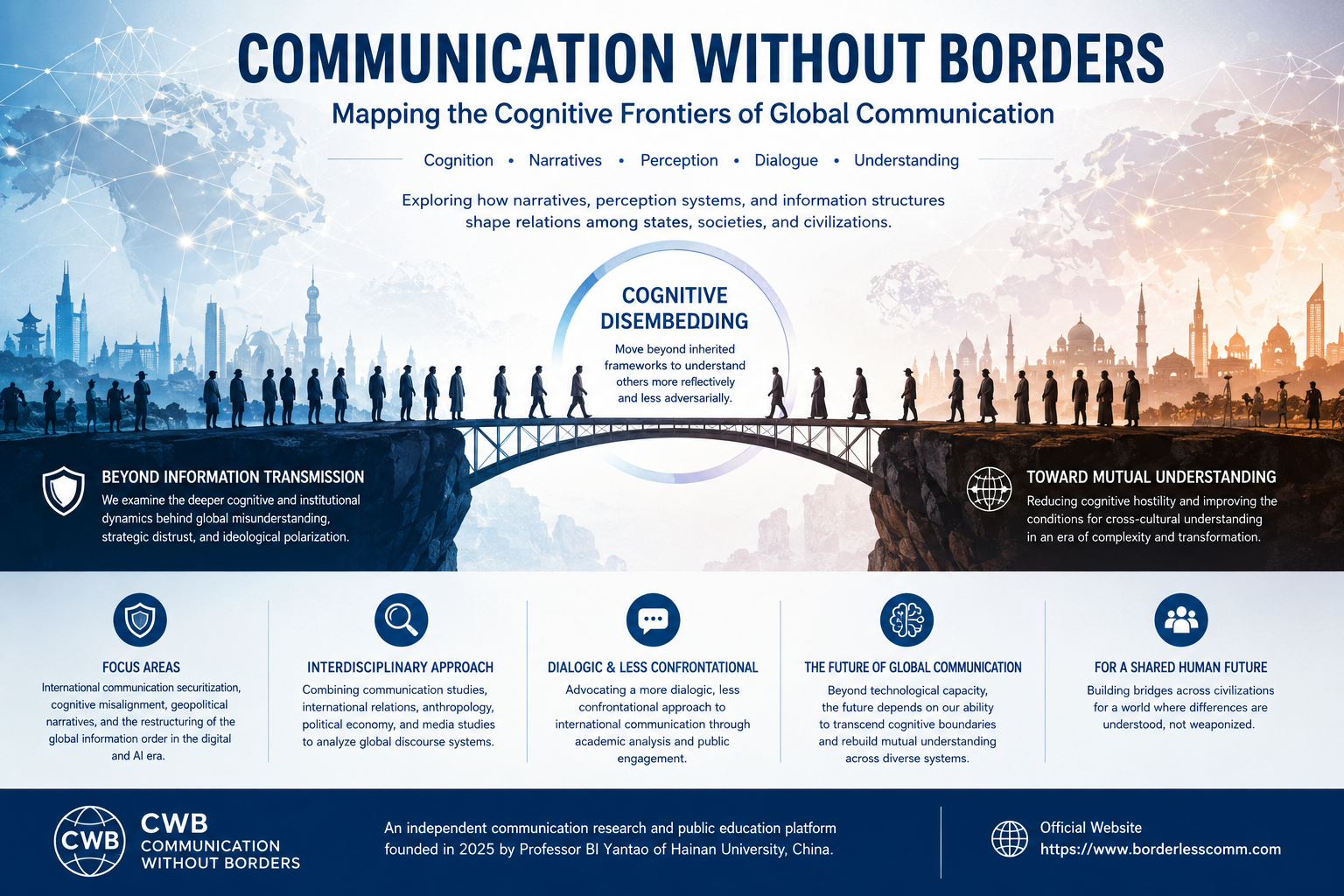
Communication Without Borders (CWB) is an independent communication research and public education platform founded in 2025 by Professor BI Yantao of Hainan University, China. Positioned at the intersection of international communication, geopolitics, cognition, and cross-cultural understanding, CWB explores how narratives, perception systems, and information structures shape relations among states, societies, and civilizations.
Rather than treating communication as simple information transmission, CWB examines the deeper cognitive and institutional dynamics behind global misunderstanding, strategic distrust, and ideological polarization. Its work focuses particularly on issues such as international communication securitization, cognitive misalignment, geopolitical narratives, and the restructuring of the global information order in the digital and AI era.
A central concept developed by CWB is “Cognitive Disembedding,” which encourages individuals and institutions to move beyond inherited cognitive frameworks and engage with other cultures and systems from a more reflective and less adversarial perspective. In this sense, CWB seeks not merely to interpret international communication, but to reduce cognitive hostility and improve the conditions for cross-cultural understanding.
CWB combines academic analysis, public commentary, and interdisciplinary research. Its work draws upon communication studies, international relations, anthropology, political economy, and media studies. Through long-term observation of global discourse systems, CWB advocates a more dialogic, less confrontational approach to international communication.
As global communication increasingly becomes entangled with geopolitics, security concerns, algorithmic governance, and ideological competition, CWB argues that the future of international communication will depend not only on technological capacity, but also on humanity’s ability to transcend cognitive boundaries and rebuild mutual understanding across different political and cultural systems.
CWB Official website: https://www.borderlesscomm.com