By Bi Yantao, Professor
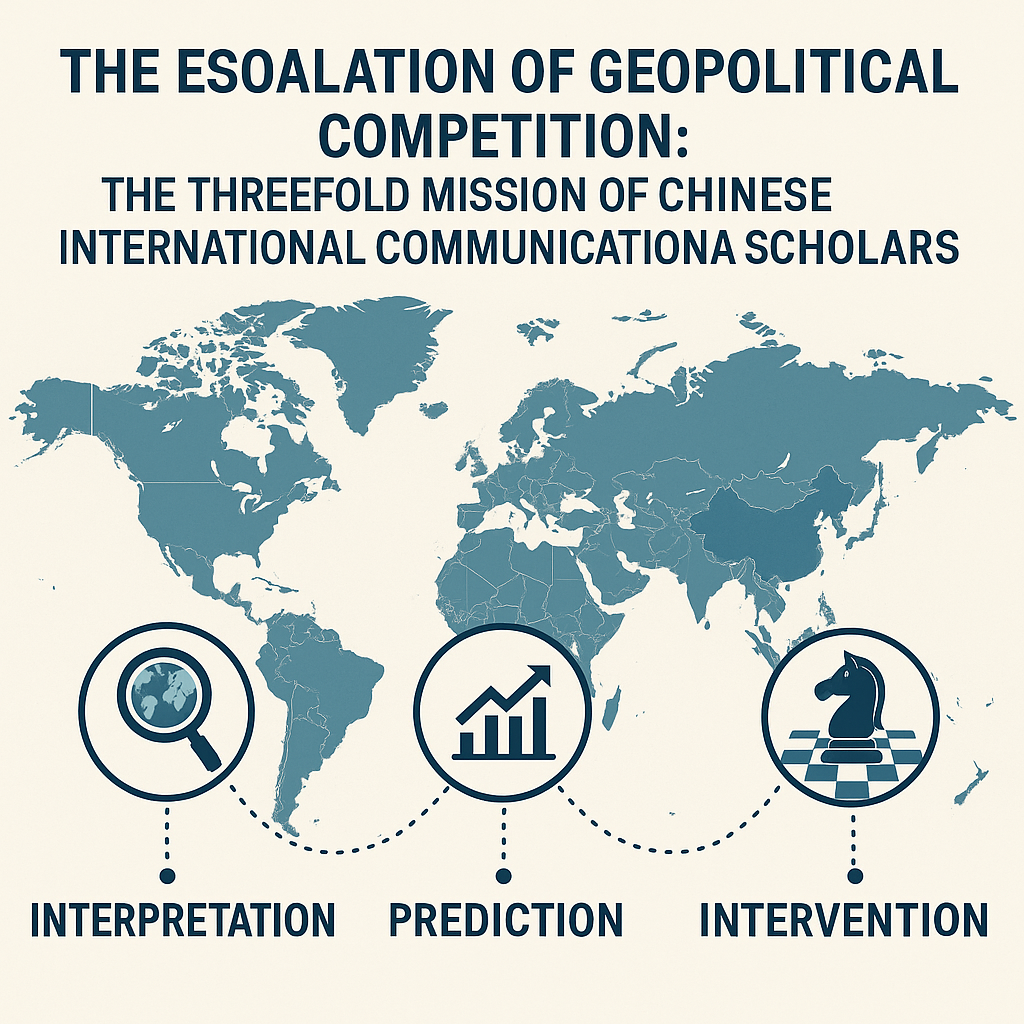
As the global order undergoes accelerated restructuring and geopolitical conflicts continue to spill over—from the Ukraine crisis to renewed warfare in the Middle East, from U.S.-China strategic rivalry to the collective awakening of the Global South—the world is entering a convergence point of multipolar competition and value realignment. In response to this intensifying geopolitical landscape, Chinese international communication scholars should break free from the traditional confines of “telling China’s story well” and reposition themselves within a broader historical context—not merely as collectors, interpreters, and transmitters of information, but as observers, deconstructors, and reconstructors of the world’s cognitive order. Against this backdrop, I argue that international communication scholars shoulder three historical missions: interpretation, prediction, and intervention.
I. Interpretation: Piercing Appearances to Construct an Explanatory Framework for Our Time
In this era of information explosion and narrative chaos, geopolitical conflicts are often obscured by emotional rhetoric, ideological projection, and manipulated public opinion. The true logic and drivers behind global events are systematically concealed. International communication scholars must transcend both technological determinism and the constraints of nationalistic narratives to reclaim the primary academic mission—to explain the world.
This explanatory effort must not be a mere reiteration of state rhetoric, nor a passive adaptation of Western theories. Rather, it must be grounded in historical structures, communication logic, and the dynamics of cognitive evolution, enabling us to construct an indigenous explanatory framework. We must clarify: How is the global arena of public opinion shaped? How are the boundaries of cognition manipulated? How are national narratives embedded in strategic competition, and how do they influence decision-making? Amid the layered façades of geopolitical maneuvering, we must possess the clarity to “see through the clouds,” reconstructing a world picture that reflects the complexity and systemic logic of global reality—for both the public and policymakers.
II. Prediction: Making Forward-Looking Judgments Based on Cognitive Communication Systems
Prediction is not the exclusive domain of policy analysts. International communication scholars, who study the flow of cognition, naturally operate at the intersection of culture, psychology, media, and politics, granting them a unique edge in understanding how global cognitive systems build consensus—or opposition. As I remarked at the First Tibet Forum on International Communication on June 29, 2013, outstanding communication scholars possess a heightened sensitivity to shifts in political currents.
Today, as cognition becomes a key battleground of strategic competition, communication logic often precedes military deployments or economic adjustments. This enables us to detect early signs of shifting geopolitical dynamics—be it a sudden change in dominant narrative, a country’s reconfiguration of strategic language, or the emergence of new public issues within the global discourse. If these early signals can be systematically identified and extrapolated, international communication scholars can make meaningful contributions to forecasting the evolution of international relations, thus complementing traditional geopolitical analysis.
III. Intervention: Leveraging Cognitive Shaping to Participate in the Construction of Global Order
In an age where “cognition is power,” international communication scholars must move beyond interpretation and prediction to become active participants in shaping the global cognitive order. Such intervention goes beyond narrow efforts at public opinion management or media strategy; it involves the deeper task of reshaping collective understanding, policy perception, and cultural imagination—thereby influencing the strategic logic at its source. In this process, scholars must act as engaged agents of “knowledge politics,” not mere information brokers or passive recipients of discourse, but architects embedded in contextual restructuring, narrative design, and the formation of global consensus.
Communication is no longer just a technical tool, but a cognitive infrastructure for states to compete for influence—a core variable in the future construction of the international order. The strategic value of international communication lies in its capacity to redefine common sense, reprioritize global issues, challenge value legitimacy, and rearticulate key concepts. For China to enhance its institutional influence, it must build systemic capacity in cognitive structures, value consensus, and strategic narratives. This requires not superficial rhetorical tactics, but a comprehensive cognitive intervention force that bridges communication, strategy, culture, and politics—its goal: to reshape cognition as a means of guiding the evolution of order and redistributing structural power in the realm of ideas.
IV. Conclusion
The essence of geopolitical competition is increasingly shifting from the control of physical space to the shaping of cognitive space. In this historic moment of transition, international communication is no longer merely a functional discipline, but a strategic knowledge system. Communicators are becoming cartographers of global cognition, shaping the very architecture of international meaning.
Chinese international communication scholars must update their paradigms—moving from the academic periphery to the strategic forefront. This is not only a transformation of role, but a call to responsibility. Only by establishing systematic methodologies and practical pathways across the three dimensions of interpretation, prediction, and intervention can we meaningfully participate in the generative mechanisms of international relations. In doing so, international communication (and its scholars) will assume a new and vital historical role, helping China attain greater power in shaping the future international order.
Bi Yantao is a Professor at the School of International Communication and Arts, Hainan University, Editor-in-Chief of Communication Without Borders, and a Senior Research Fellow at the Charhar Institute.