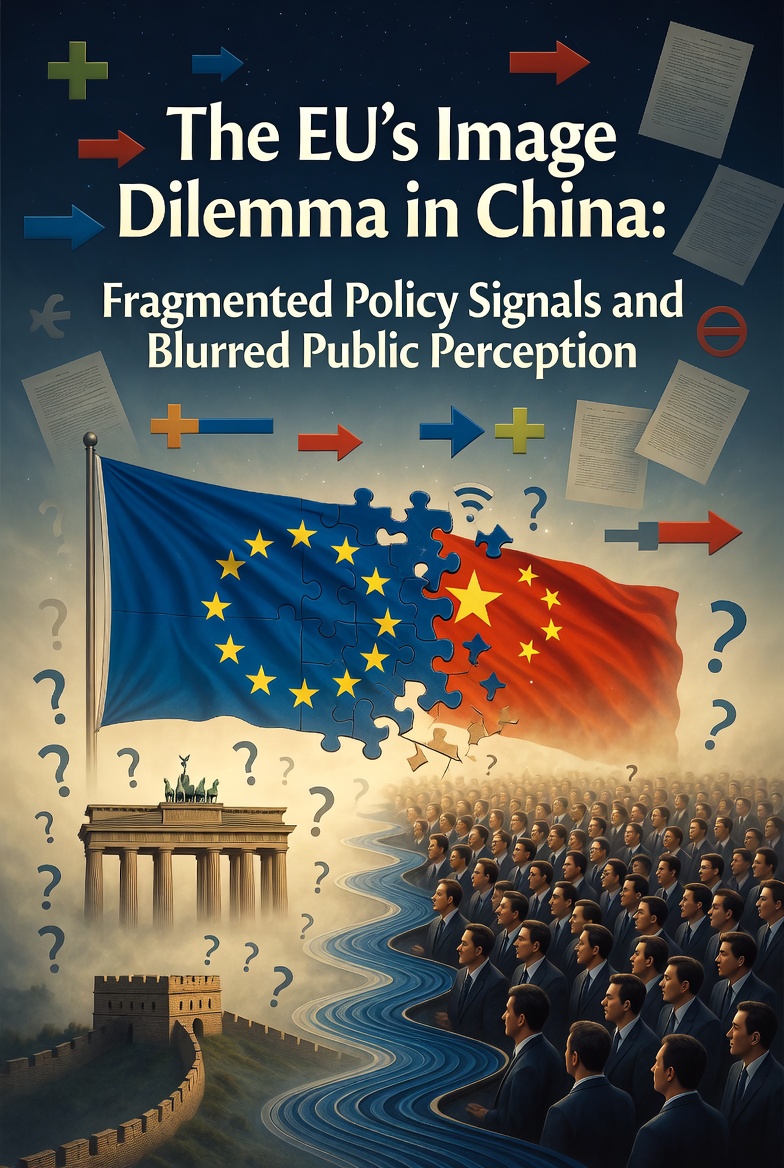
Under the interaction of multiple policy signals and dispersed narratives, the European Union’s image in China is gradually evolving into a paradoxical condition: visible, yet difficult to clearly identify.
By Bi Yantao
Published on May 23, 2026
Against the backdrop of an accelerating restructuring of the global communication order, the European Union’s overall image in China has entered a noteworthy phase. The issue is not absence, but rather the difficulty of being clearly recognized. Although existing surveys and studies on this phenomenon remain limited and unsystematic, they point toward a consistent trend: the “blurring” of the EU in Chinese public perception is shifting from an individual impression to a structural outcome of communication dynamics.
I. Polling and Empirical Observations: Recognition Exists, but Fails to Stabilize
Available data suggest that Chinese public perceptions of the EU remain in a relatively stable state of “low-definition cognition.”
First, in cross-national opinion surveys, the EU has consistently failed to develop a highly coherent image comparable to that of the United States. Research conducted by Pew Research Center, for example, shows that Chinese respondents often hold relatively favorable views of major European countries such as Germany and France. However, when questions shift toward “the European Union as a whole,” perceptions become significantly more ambiguous. This suggests that, within the cognitive structure of Chinese audiences, the image of “the EU as an integrated entity” has not been effectively consolidated.
Second, within the EU’s own survey system, sustained tracking of external perceptions remains insufficient. The “Eurobarometer” surveys published by the European Commission have long focused primarily on internal identity within member states, while systematic data regarding external audiences — including the Chinese public — remain extremely limited. This “internally strong, externally weak” structure of perception measurement makes it difficult for the EU to accurately monitor shifts in its image in China.
Third, surveys targeting business and elite communities provide more concrete supporting evidence. Annual reports released by the European Union Chamber of Commerce in China have repeatedly noted that Chinese society’s understanding of the EU is “present but not concrete,” and that EU policy signals are “complex and difficult to interpret.” Even among groups with relatively strong information access capabilities, the EU still lacks a stable and recognizable collective image.
II. From “Insufficient Communication” to Structural Defocusing
The deeper problem lies in the absence of a structural framework capable of integrating EU-related information in China.
In practice, information about the EU is not scarce. Yet such information is often highly fragmented, making it difficult for audiences to form a stable structure of meaning.
From a communication perspective, this “defocusing” manifests itself at three levels.
First, information inputs lack unified encoding. Messages originating from different sources frequently diverge in values, policy positions, and modes of expression, making it difficult for audiences to place them within a single interpretive framework. For example, narratives emphasizing cooperation and openness coexist with narratives centered on risk and restriction. When these signals are received simultaneously without sufficient interpretive mediation, cognitive conflict becomes likely.
Second, the EU lacks a clear narrative center. In national communication systems, there is usually a relatively identifiable narrative core responsible for integrating external messaging and providing interpretive pathways. In the EU’s communication toward China, however, such a center is not readily visible. Messages from different institutions, member states, and media channels coexist without effective coordination, producing a fragmented overall narrative.
Third, audiences lack a stable frame of reference. For Chinese audiences, the EU is neither a traditional nation-state nor a conventional international organization. Its institutional complexity itself raises the cognitive threshold. In the absence of sustained explanation, audiences tend to substitute familiar national images for an understanding of the EU as a collective entity, thereby weakening the EU’s independent identity.
In this sense, the EU’s image dilemma in China is fundamentally a mismatch between communication structures and cognitive structures.
III. Fragmented Policy Signals and Their Communication Effects
This structural problem is particularly evident in the EU’s policy discourse toward China.
In recent years, official EU documents have simultaneously defined China as a partner, an economic competitor, and a systemic rival. While this multidimensional positioning has a realistic policy basis, it has also generated clear “signal fragmentation” in communication terms.
Specifically, the EU continues to project cooperative signals in areas such as climate change, trade, and investment, while increasingly emphasizing narratives of risk and precaution in fields such as technology, data governance, and industrial security. For example, while advancing mechanisms for economic dialogue, the EU has also strengthened scrutiny over digital platforms and critical technologies.
These policies are not necessarily contradictory. However, in communication practice, the absence of a coherent interpretive framework often causes audiences to perceive them as signs of inconsistency or strategic ambiguity. As a result, expressions emerging from the same actor across different issue areas fail to converge into a coherent cognitive impression.
From a communication studies perspective, this represents a classic case of highly complex signals that have not been effectively encoded.
IV. Blurred Public Perception: Triple Disjunctions of Actor, Narrative, and Issue
The fragmentation of policy signals ultimately translates into structural ambiguity at the level of public perception.
The first challenge concerns actor identification. As a multi-level political structure, the EU’s external communication involves both EU institutions and member states. For example, the European External Action Service and the governments of member states often communicate externally at the same time, yet the boundaries between them are not always clear. Consequently, Chinese audiences frequently conflate “the EU” with specific European countries or fail to distinguish between them.
The second issue is the dispersion of narrative sources. The EU lacks a dominant communication channel in China. Its image is often mediated indirectly through Chinese media reinterpretation or international events. Although institutions such as the EU Delegation to China are responsible for external communication, their overall influence remains limited. As a result, the EU’s image is shaped largely through external construction rather than autonomous narrative formation.
The third issue concerns the changing issue structure. In recent years, as technology, industry, and data governance have become increasingly important, EU-China issues have gradually entered a “security-oriented discourse.” This shift has made related information more conflict-driven and more likely to generate cognitive polarization. Under conditions where cooperation and precaution coexist, it becomes difficult for the public to form stable overall judgments.
V. Structural Constraints: Why the Dilemma Is Unlikely to Ease Quickly
The EU’s image dilemma in China cannot be easily resolved through short-term communication strategies alone. Multiple structural constraints underpin the problem.
First, the EU’s multi-centered institutional structure makes it difficult to establish a unified narrative. The relative independence of EU institutions and member states in external communication means that information outputs cannot be fully coordinated.
Second, the persistence of multiple policy objectives ensures that signal complexity will continue. The tripartite positioning of “partner–competitor–rival” is unlikely to disappear in the foreseeable future.
Third, external communication still occupies a relatively limited priority within the EU’s broader governance agenda. Compared with internal integration, systematic communication efforts directed toward Chinese audiences remain insufficient.
VI. Conclusion: A “Visible but Difficult-to-Identify” International Actor
In essence, the EU’s image dilemma in China can be understood as a typical structural cognitive problem: information is continuously present but difficult to integrate; the actor consistently exists but lacks clear boundaries; policies are constantly communicated but without a unified explanatory framework. The result is that the EU appears in China as a “visible but difficult-to-identify” international actor.
As international communication becomes increasingly securitized, this condition may intensify further. When stable cognition fails to form, the probability of misinterpretation rises correspondingly, and the space for cooperation may narrow as a result. The implications of this trend may extend well beyond the realm of “image problems” and enter deeper layers of international relations and cognitive structures.
Bi Yantao is Professor at the School of International Communication and Art, Hainan University, and Senior Research Fellow at the Charhar Institute. The views expressed in this article are solely those of the author and do not represent the positions of the institutions with which he is affiliated.