
Author: Bi Yantao
Publication on June 10, 2026
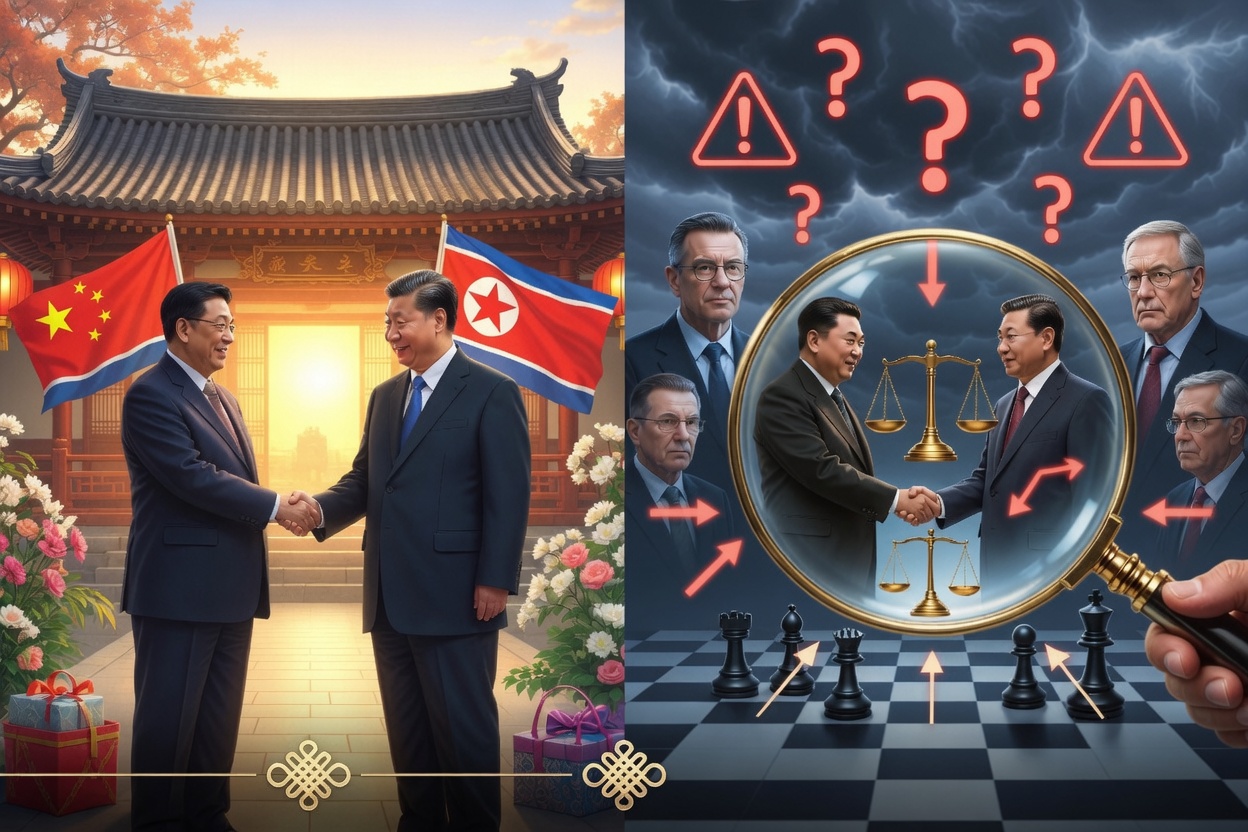
After Chinese President Xi Jinping’s recent visit to North Korea, many Western media outlets quickly offered their interpretations. Terms such as “influence competition,” “strategic game,” “geopolitical maneuvering,” “balancing Russia,” and “countering the US and Japan” appeared frequently in reports and commentaries.
Some analysts even suggested that the visit was “more symbolic than substantive,” citing the absence of major agreements or new strategic announcements.
However, from a Chinese perspective, such analyses likely misread the essential nature of the visit. The issue lies not in a lack of information, but in the limitations of the analytical framework Western media use to interpret the event.
1. Why Do Western Media Always Look for a “Hidden Agenda”?
For a long time, Western international relations studies have been heavily influenced by realist theory. Within this framework, states are viewed as rational actors pursuing power, security, and interests. Interactions between countries are typically interpreted as struggles for influence, interest exchanges, and strategic games.
Therefore, when Xi Jinping visits North Korea, many Western analysts’ first questions are: “Why are the two sides maintaining contact?” “What does China want to gain?” “What can North Korea offer?” and “Who is competing for influence over North Korea?”
Under this lens, the visit itself seems meaningless; what matters are the hidden strategic objectives behind it. A relatively straightforward diplomatic activity is thus layered with complex strategic speculation.
The problem is that many of these interpretations lack direct supporting evidence. What public reports can confirm is that the visit took place, talks were held, and both sides expressed willingness to continue developing bilateral relations. Claims about “competing for influence,” “balancing Russia,” or “countering the United States” are mostly speculative inferences based on existing theoretical frameworks rather than verified facts.
2. Chinese People Understand Relationships Differently
If many ordinary Chinese people were to explain this visit, they might offer a simpler interpretation: it was “visiting relatives.”
Here, “visiting relatives” is not literal, but refers to a particular logic of relationships. In Chinese society, interactions between relatives do not always need to solve specific problems or produce concrete outcomes each time. Often, simply meeting, chatting, and maintaining contact holds value in itself.
This is a very common social experience for Chinese people.
However, many Western observers tend to understand international relations through a transactional logic. They often believe that a visit only has real significance if agreements are signed, projects are announced, or concrete results are achieved.
Thus, when they see no such outcomes, they easily conclude that it was merely a “symbolic visit” lacking substantive content. In doing so, they overlook one key point: the relationship itself has value.
3. The Overlooked Function of “Maintaining Relationships”
American communication scholar James Carey proposed the “ritual view” of communication. According to this perspective, communication is not only about transmitting information but also about maintaining community.
Some interactions aim to exchange content, while others serve to confirm and maintain relationships. From this angle, high-level visits do not necessarily need to resolve specific issues; they also fulfill the function of relationship maintenance and confirmation — especially in China-North Korea relations.
In diplomatic practice, state visits, commemorative activities, exchange of congratulatory messages, and leaders’ meetings all carry clear ritual characteristics. Often, the ritual itself is the meaning.
When the top leaders of both countries meet, the primary message received by the outside world is: both sides still value their relationship, communication channels remain open, and both are willing to continue developing bilateral ties. These messages may not translate into formal agreements, but they still have real-world impact.
Therefore, simply equating “symbolic” with “lacking practical significance” is itself a misunderstanding.
4. Why Does the West Easily Misread China-North Korea Relations?
The root of the problem may not be that Western media lack knowledge of North Korea, but that they habitually interpret the world through their own experiences.
In Western political culture, international relations are largely understood as contractual and interest-based relationships. In East Asian cultural traditions, relationships often hold intrinsic value.
This difference exists not only between states but also between individuals. When Chinese people say “come and go often,” the emphasis is on the “coming and going.” When Western analysts observe the same behavior, their focus is often on the “purpose.”
As a result, the same event receives vastly different interpretations: Chinese people see continuity of relationship; Western media see strategic calculation. Chinese people see ongoing friendly exchanges; Western media search for hidden agendas.
This does not mean one side is completely right and the other completely wrong. It shows that an observer’s own cultural background and cognitive framework profoundly influence their judgment of an event’s meaning.
5. To Understand the World, We Must Also Understand the Observers
International communication studies tell us that news reporting is never a simple reproduction of reality, but a process of selection, organization, and interpretation.
The same event can be told as completely different stories by different media. Xi Jinping’s visit to North Korea is a classic example.
For many Western media outlets, it was a geopolitical event. For many Chinese people, it was first and foremost a relationship event.
If we ignore these cognitive differences, it becomes easy to mistake relationships for transactions, exchanges for games, and friendliness for calculation.
In this sense, the inspiration from Xi Jinping’s visit to North Korea may extend beyond China-North Korea relations — it is also about how we understand the world.
When the West habitually views everything through the lens of power competition, even a simple “visit to relatives” can be interpreted as a power game.
About the Author: Bi Yantao is a professor of communication studies, specializing in international communication, international conflict, and peace studies. This article represents the author’s personal views only and does not represent the position of any institution.