
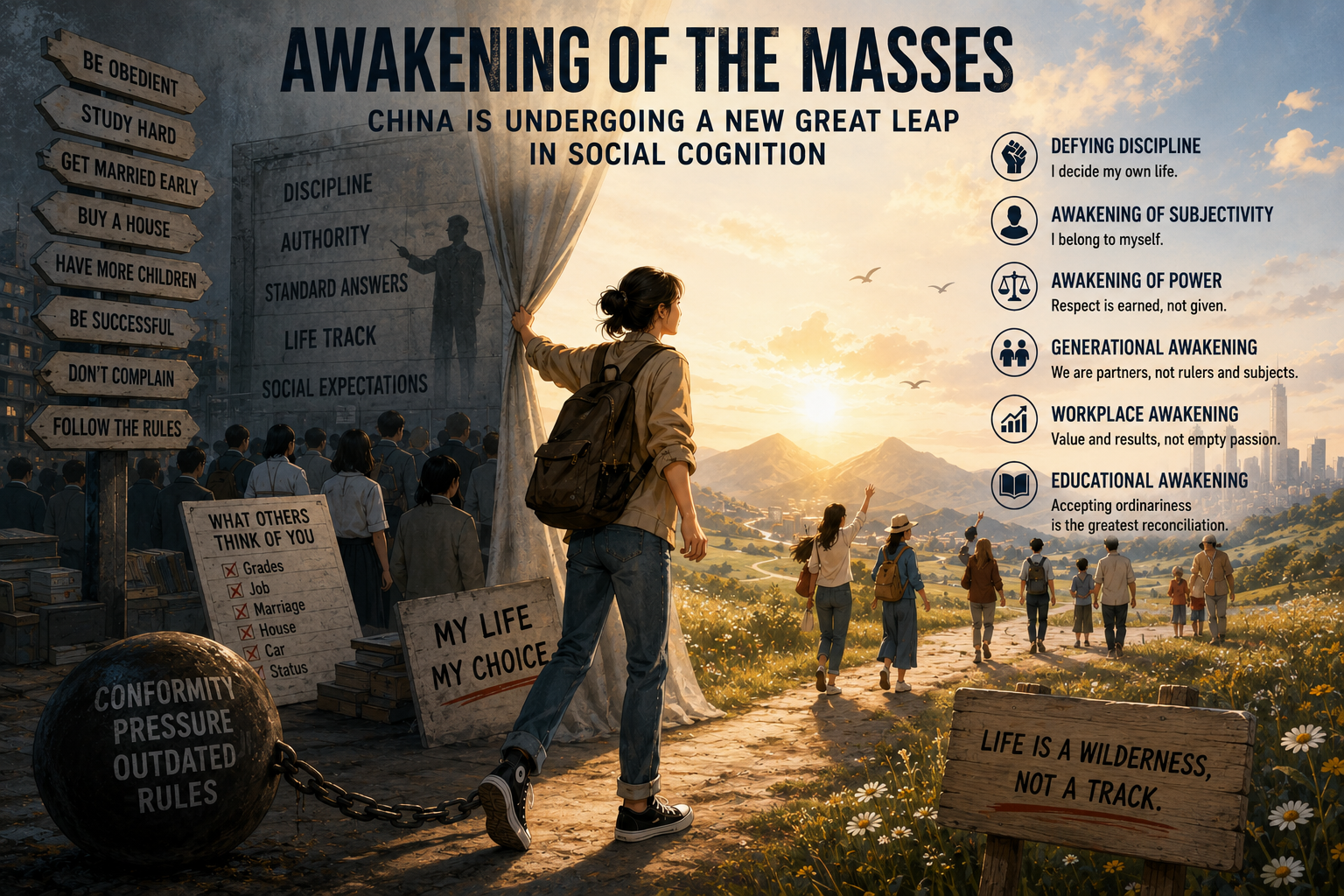
If you still think the word “awakening” sounds pretentious or mystical, that may itself suggest you have not fully awakened yet.
By Bi Yantao
Published on May 24, 2026
From social media feeds to office break rooms, from family group chats to late-night drinking sessions, a cognitive earthquake involving hundreds of millions of people is unfolding across China in 2026. It is not the “spiritual civilization” described in official rhetoric, nor the self-help slogans promoted by motivational influencers. It is a systemic, irreversible transformation in social consciousness emerging from deep within society itself.
This transformation has no central command and no roadmap, yet it is occurring simultaneously across six core dimensions.
I. The Rise of Defiance: “You Have No Right to Tell Me How to Live”
What is social discipline? It is the lifelong process through which countless people tell you what you should and should not do; what is right and wrong; what counts as success and failure.
Parents say: you should be obedient.
Teachers say: you should study hard.
Bosses say: you should have a “wolf mentality.”
Society says: you should get married before thirty.
Experts say: you should delay gratification and have more children.
In the past, these ideas were treated as unquestionable truths. Today, many young people respond with a single word: “No.”
This is not simple rebellion. It is disenchantment. Increasingly, people are asking a basic question: “What gives you the authority to educate me?”
“Life is not a railway track but a wilderness” has become an overused phrase, but those who truly understand it are the people who have already stepped off the track and are stumbling through the wilderness themselves.
The most visible resistance to social discipline appears in the rejection of the traditional “life timetable.” Being unmarried at thirty was once labeled a failure; now many simply reply: “Mind your own business.” Not having children was once condemned as unfilial; now the response is: “Will you raise them for me?” Refusing to buy a house was once seen as lacking ambition; now it is framed as refusing to carry thirty years of debt.
There is also a subtler form of discipline: the coercion of “positivity.” If you feel anxious, depressed, or frustrated, someone immediately tells you to stay optimistic, grateful, and energetic. Increasingly, young people refuse that demand. They insist that emotions do not require approval and suffering does not need to be romanticized as “growing pains.”
The sharpest challenge, however, is directed at the discipline of “responsibility.”
For years, people were told: you are part of the nation, so you must prioritize the greater good; you are the pillar of the family, so you must shoulder responsibility; you are a participant in this era, so you must contribute and sacrifice.
But many young people have gradually recognized what they see as a contradiction: when responsibility is required, you are called a “stakeholder”; when benefits are distributed, you become an outsider.
A darkly humorous phrase spread widely online:
“No one invited me to the party of luxury and excess, but when the world collapses, suddenly it’s all my responsibility.”
Why did this resonate so deeply? Because it exposed a perceived asymmetry: ordinary people often feel excluded from prosperity yet expected to bear the costs when sacrifice is demanded.
This is not indifference. It is a demand for fairness. Social discipline depends on an implicit contract: if society treats me fairly, I will reciprocate. If the burdens are socialized while the rewards remain concentrated elsewhere, many increasingly refuse to accept the arrangement.
At its core, this awakening says one thing:
“My life belongs to me. I do not need anyone’s permission to live it.”
II. The Awakening of Subjectivity: “I Finally Realized I Belong to Myself”
The term “subjectivity” has surged in popularity across Chinese social media because many people increasingly feel they have spent decades living according to external evaluation systems.
People studied to satisfy parents, worked to gain approval from superiors, married to avoid gossip, and had children because society expected it. Behind every choice was the same question: “What will others think of me?”
That logic is changing.
Popular online phrases about “having a seat at the table” resonate because many people previously felt excluded from meaningful participation. Increasingly, young people are saying: “I not only want a seat at the table, I want the right to choose what matters to me.”
The viral phrase “love yourself” has also evolved from a cliché into a practical ethic: rejecting exhausting social obligations, leaving emotionally draining relationships, and refusing to sacrifice oneself endlessly for people or institutions that offer little in return.
The psychological shift can be summarized simply:
“I strive in order to recognize myself, not merely to be recognized by others.”
III. The Awakening of Power: “Who Exactly Do You Think You Are?”
This may be the sharpest and most politically sensitive dimension of all.
Put bluntly: many Chinese people no longer grant automatic deference to authority. Respect itself has not disappeared; unconditional respect has.
In the past, workplaces often operated on the assumption that “the boss is always right.” Increasingly, younger employees demand evidence and competence rather than positional authority.
Experts, influencers, and celebrities are now routinely questioned, criticized, and publicly challenged online. A widely shared comment captured this shift:
“I respect your ability, not the chair you are sitting in.”
This is not merely rebellion. It reflects the collapse of traditional authority filters in the internet era. Once information asymmetries shrink and ordinary people can compare data, verify claims, and access primary sources directly, legitimacy increasingly depends on persuasion rather than hierarchy.
The deeper transformation is psychological: ordinary people increasingly feel entitled to evaluate authority figures rather than simply obey them.
Equality, in this sense, is not granted from above. It is asserted from below.
IV. Generational Awakening: “Parents, We Are Partners Now”
Family relationships are also undergoing a quiet redistribution of power.
Traditionally, Chinese family ethics centered on filial piety — a hierarchical model built on obedience and repayment. Increasingly, younger generations are reframing family relationships as partnerships between adults.
A popular phrase, “raising your parents again,” reflects this shift. It does not mean abandoning filial responsibility. Rather, it means interacting with parents through equality, empathy, and emotional reciprocity rather than unquestioned obedience.
Helping parents navigate technology, taking them to exhibitions, or supporting their emotional well-being are increasingly viewed not as duties imposed by hierarchy, but as mutual care between equals.
At the same time, younger people are becoming less willing to tolerate emotional coercion framed as “I’m doing this for your own good.”
The result is a gradual transition from emotionally draining family structures toward more negotiated and reciprocal relationships.
V. Workplace Awakening: “Stop Talking to Me About Passion, Talk About Money”
The old keyword of “involution” is fading. In 2026, the dominant workplace logic is ROI — return on investment.
Young workers increasingly calculate everything pragmatically: Will overtime actually improve my career prospects? Will learning new skill increase my income? Will this networking event generate real opportunities?
If the answer is unclear, many refuse to participate.
As one popular online summary put it:
“In the past, competition was about who could endure more.
Now it is about who can calculate better.”
This reflects a broader shift: hard work itself is no longer automatically glorified. People increasingly distinguish between meaningful effort and pointless sacrifice.
Middle-class professionals over thirty-five are also reassessing their lives: selling expensive school-district apartments, reducing unnecessary social obligations, and abandoning costly educational competitions for their children.
This is not necessarily “lying flat.” It is strategic withdrawal — reallocating resources away from social comparison and toward personal well-being.
Among delivery drivers and other precarious workers, the awakening is even harsher. One rider summarized it painfully:
“I used to think riding faster meant I was capable.
Now I think it means I’m shortening my life.”
What emerges here is not merely frustration but the early formation of structural consciousness: once enough people begin asking “Why is the system like this?”, broader social questioning becomes inevitable.
VI. Educational Awakening: “Accepting My Child’s Ordinary Humanity Is My Greatest Reconciliation”
The educational awakening arrived later than the others, but perhaps it cuts deepest.
For years, China’s middle class embraced an escalating culture of hyper-competitive parenting: Olympiad math, English tutoring, coding, piano lessons, horseback riding — every possible advantage pursued simultaneously.
But many families are now reassessing the equation. The costs are enormous, while the perceived returns increasingly appear uncertain amid credential inflation and economic pressure.
More parents are beginning to say: “I no longer expect my child to become extraordinary. I just hope they are mentally healthy, emotionally stable, and capable of supporting themselves.”
Another parent summarized the shift this way: “Healthy parents, a relaxed family atmosphere, and sufficient savings are the real starting line for a child.”
This is not surrender. It is a transition from “hoping children become dragons” to simply hoping they become healthy and complete human beings.
The deepest realization may be this: parents themselves are ordinary people. If they could not achieve perfection, on what basis can they demand it from their children?
Accepting a child’s ordinariness is, ultimately, a reconciliation with one’s own.
Conclusion: This Is Not Celebration — It Is Reckoning
The awakening of the masses is not a carnival. It is a collective reckoning: a reassessment of norms once treated as natural, authorities once obeyed without question, and values once accepted as eternal.
The process will be painful and disorderly. Some will lament moral decline. Others will long nostalgically for the past.
But the process is unlikely to reverse, because once people awaken, they rarely return willingly to sleep.
Bi Yantao is a Chinese professor of communication studies whose primary research focuses on international communication, conflict, and peace. The views expressed in this article are solely those of the author and do not represent the positions of affiliated institutions.