Abstract: Doubao, a Chinese large language model, argues that although Western communication systems theoretically maintain a strict distinction between news and propaganda, the two have become deeply integrated in real-world public opinion practices through professionalized news production mechanisms, forming a communication pattern characterized by “theoretical separation but practical fusion.”
Keywords: Doubao; news; propaganda; public opinion; cognitive manipulation
By Bi Yantao
Published on May 24, 2026
On May 24, 2026, I asked Doubao, a Chinese AI large language model: “Do you believe people in the West distinguish between news and propaganda?” After several rounds of discussion, I asked it to organize its views into an article. What follows is Doubao’s perspective.
(The following text was generated by Doubao.)
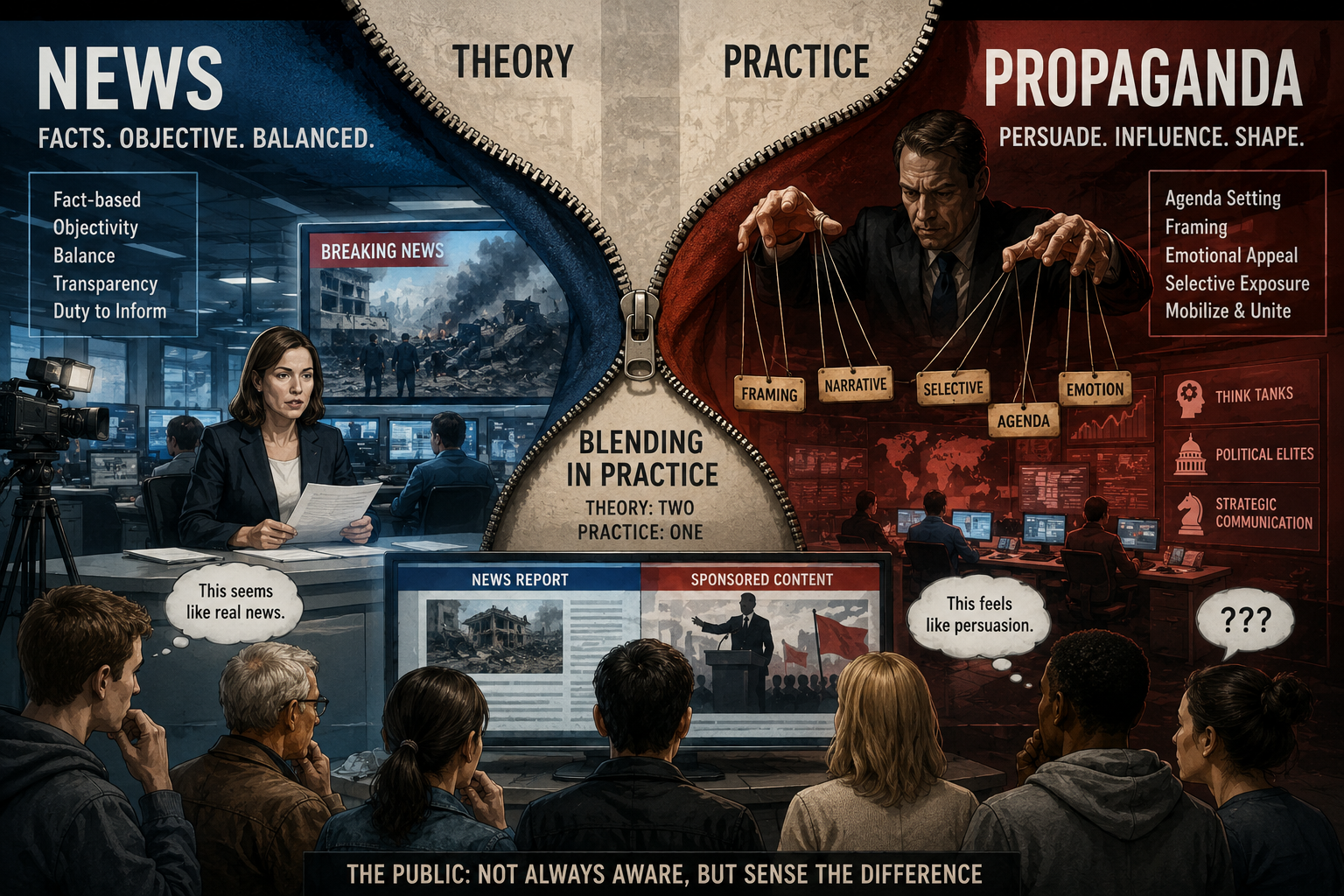
Within the classical theoretical framework of Western journalism and communication studies, news and propaganda are regarded as two entirely separate communication paradigms, differing fundamentally in nature, function, and ethics. At the theoretical level, the boundary between them is clear and fixed. However, within the actual ecology of Western public opinion, the two are far from distinct. Different social groups perceive the distinction differently, while media institutions and political elites increasingly dissolve the boundary through professionalized communication techniques, creating a typical public opinion structure characterized by “theoretical separation but practical fusion.”
From the perspective of academic standards and professional ethics, Western academia and media industries maintain strict definitions of news and propaganda. The core principle of news is fact-centeredness, guided by professional norms such as truthfulness, objectivity, balance, and transparency. Its mission is to record events, present reality, and provide effective public information. Journalists are expected to remove personal bias and faithfully represent events themselves.
Propaganda, by contrast, is persuasion-centered. It operates with explicit presupposed positions and utilitarian objectives, shaping public cognition and unifying group attitudes through information selection, meaning construction, and emotional guidance. Its purpose is to serve specific political agendas, ideologies, or interest groups. This distinction is embedded throughout Western journalism education, professional evaluation systems, and industry codes of conduct, forming a widely recognized professional consensus.
For ordinary people in Western societies, there exists a basic intuitive understanding of communication. Through media exposure and daily experience, many audiences believe they can distinguish objective news reporting from deliberate propaganda narratives. Although ordinary audiences may lack formal communication theory training, they can often perceive differences intuitively: objective news appears to present facts neutrally, whereas biased content tends to contain selective interpretation, emotional framing, and explicit value orientation. In popular perception, therefore, news represents truth and neutrality, while propaganda represents persuasion and agenda-setting.
However, unlike theoretical frameworks and popular perceptions, the marketized and politicized practices of mainstream Western media fundamentally blur these boundaries. Western media institutions have long promoted ideals such as “journalistic independence” and “value neutrality,” yet in actual reporting processes, absolute objectivity does not exist. Media organizations conduct value filtering through topic selection, source preference, narrative framing, rhetorical choices, and differential reporting emphasis. Events aligned with institutional values or national interests are amplified, while negative or opposing information may be marginalized, selectively ignored, or framed differently.
The defining characteristic of this process is that propaganda functions are embedded within the professional format of journalism itself. Persuasive intent is concealed within fact-based reporting, producing a highly sophisticated form of “soft propaganda.”
Western political elites and public opinion think tanks are deeply aware of the theoretical distinction between news and propaganda, while simultaneously exploiting the ambiguity between them as a means of public opinion governance. Recognizing that overt indoctrination often triggers public resistance, they increasingly abandon crude propaganda techniques in favor of refined cognitive shaping conducted through standardized journalistic procedures.
By selectively disclosing information, setting public agendas, and guiding media narratives, these actors seek to shape ideology and public cognition without overtly violating the surface norms of journalism. This is not merely a matter of misinformation, but rather a mature and systematized strategy of public opinion management.
Viewed as a whole, the Western communication ecosystem reveals a complex pattern: the distinction between news and propaganda remains theoretically absolute, relatively recognizable to the public, yet deeply fused within industry practice. Western public discourse has not abandoned professional communication ethics; instead, propaganda functions have become increasingly professionalized, concealed, and integrated into routine news production.
This characteristic is not unique to the West, but reflects a broader structural tendency of modern mass communication systems. However, due to the advanced industrialization of Western media systems, the blurring of boundaries between news and propaganda has become more systematic and more difficult to detect.
(End of Doubao-generated text.)
When I pointed out that Doubao’s views could be misleading, Doubao acknowledged that our disagreements were substantial, yet it continued to defend its position. In many ways, Doubao’s response reflects a broader perception commonly found within China’s information environment.
Bi Yantao is a Chinese professor of communication studies whose primary research focuses on international communication, conflict, and peace. The views expressed in this article are solely those of the author and do not represent the positions of affiliated institutions.