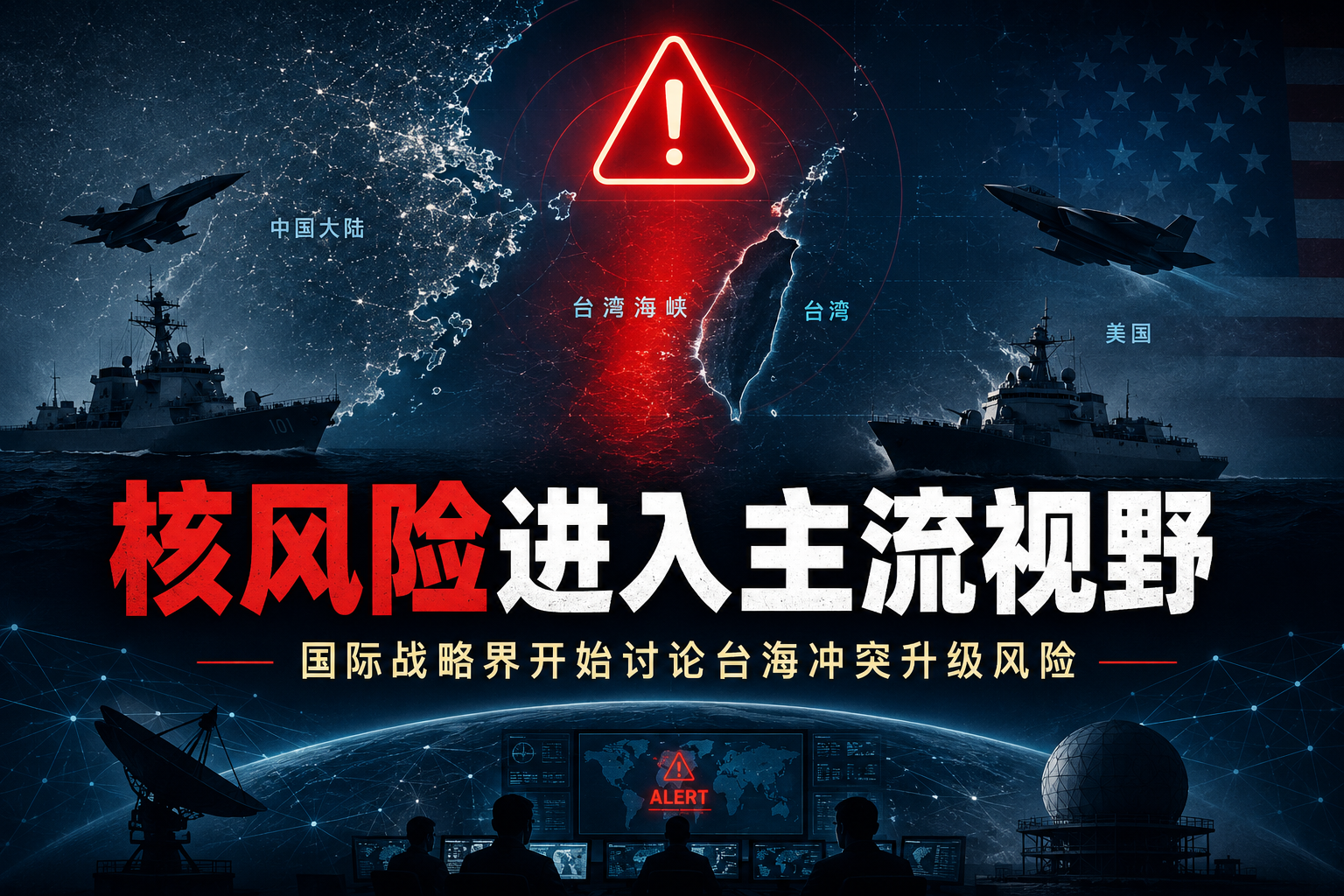
Nuclear war in the Taiwan Strait remains a low-probability scenario. Yet when an increasing number of authoritative institutions begin studying this risk, it can no longer be dismissed as a remote theoretical possibility.
By Bi Yantao
Published on May 31, 2026
Traditionally, international discussions about the Taiwan Strait have focused on a single question: Will a war break out?
Since 2024, however, a notable shift has emerged within the strategic community. An increasing number of major security institutions and research teams have begun examining a topic that was once considered highly sensitive: if a military conflict were to occur in the Taiwan Strait, could it escalate to the nuclear level?
These discussions do not imply that nuclear war is imminent. They do, however, suggest that nuclear risk is no longer confined to fringe speculation. Instead, it is becoming part of mainstream strategic analysis, crisis simulations, and risk-management studies.
I. IISS Warns of Nuclear Escalation Risks in a Taiwan Strait Conflict
In May 2026, the International Institute for Strategic Studies (IISS) issued a warning in its annual strategic assessment that any military conflict between China and the United States over Taiwan could carry risks of nuclear escalation.
According to IISS, one of the critical challenges in a future conflict is that both sides may target each other’s command, communications, intelligence, and early-warning systems. These systems often serve both conventional military operations and nuclear command functions.
In a high-intensity conflict, a state may find it difficult to determine whether an attack is intended merely to degrade conventional military capabilities or to undermine its nuclear deterrent. Such uncertainty could increase the risk of strategic miscalculation.
It is worth noting that IISS is not an ordinary research institution. Its annual Military Balance report is widely regarded as an authoritative reference by defense establishments around the world.
Therefore, the decision by IISS to formally incorporate nuclear-escalation risks into its Taiwan Strait assessments is itself a significant strategic signal.
II. The U.S. Strategic Community Is Examining Nuclear Escalation Scenarios
Beyond IISS, the American strategic research community has also shown growing interest in Taiwan-related nuclear risks.
In 2024, the Center for Strategic and International Studies (CSIS) and the MIT Security Studies Program completed a wargaming project focused on a potential Taiwan Strait conflict.
The research team conducted fifteen simulation rounds. The central questions were not who would win a war, but rather: What factors could cause nuclear deterrence to fail in a U.S.-China conflict over Taiwan? Under what circumstances could escalation pressures intensify?
Researchers paid particular attention to decision-making stress, information failures, and breakdowns in strategic communication.
The project reflects an important trend: more strategic analysts are treating nuclear risk as an integral component of Taiwan Strait crisis studies.
III. China and the United States Are Renewing Attention to Nuclear Risk Communication
At the same time, another important development deserves attention.
In 2024, China and the United States resumed unofficial nuclear discussions after years of interruption.
According to Reuters, scholars and former officials from both countries participated in a Track Two Nuclear Dialogue, in which Taiwan-related contingencies were among the topics discussed.
Reports indicate that Chinese participants reiterated China’s longstanding nuclear policy, including its commitment to a no-first-use posture.
This development suggests that as strategic competition intensifies, both Beijing and Washington recognize the importance of risk management.
In other words, while concerns about Taiwan-related nuclear risks are growing, efforts are also being made to strengthen communication mechanisms and reduce the possibility of uncontrolled escalation.
IV. Why Is Nuclear Risk Receiving Greater Attention?
For much of the post–Cold War era, nuclear war was generally viewed as an extremely unlikely event. Today, however, the strategic environment is changing.
Modern warfare increasingly depends on satellites, communications networks, early-warning systems, and data links. These assets support conventional military operations, but they may also play roles in strategic deterrence.
In a conflict, both sides would likely seek to disable such critical systems at an early stage.
The challenge is that when a country sees its warning networks, communications infrastructure, or command systems under attack, it may not be able to determine the attacker’s true intentions.
Under conditions of extreme tension, uncertainty itself can become a source of risk.
As a result, current strategic discussions are focused less on nuclear weapons themselves and more on how to prevent miscalculation, misunderstanding, and uncontrolled escalation during a crisis.
V. A Strategic Signal Worth Attention
Perhaps the most significant development today is not whether nuclear war will occur. Rather, it is that an increasing number of respected institutions have begun studying the possibility seriously.
In the past, nuclear war was largely confined to worst-case scenarios and theoretical debates. Today, it is appearing in formal strategic assessments, crisis simulations, and risk-management studies.
This shift does not mean that war is inevitable.
It does, however, indicate that the international strategic community is reassessing the risks associated with great-power competition in the twenty-first century.
For the world, the key challenge is not who is generating risk narratives, but how to prevent accumulating misperceptions and strategic mistrust from pushing all sides toward outcomes that no one truly desires.
In this sense, the emergence of nuclear risk as a mainstream topic of strategic discussion is itself a development that deserves close attention.
About the Author
Bi Yantao is a professor at the School of International Communication and Art, Hainan University, and a Senior Research Fellow at the Charhar Institute. His research focuses on international communication, international conflict, and peace studies.
The views expressed in this article are solely those of the author and do not represent the positions of the institutions with which he is affiliated.