The future of Taiwan has long been the subject of two sharply contrasting narratives in the Chinese-speaking world.
By Bi Yantao
Published on June 1, 2026
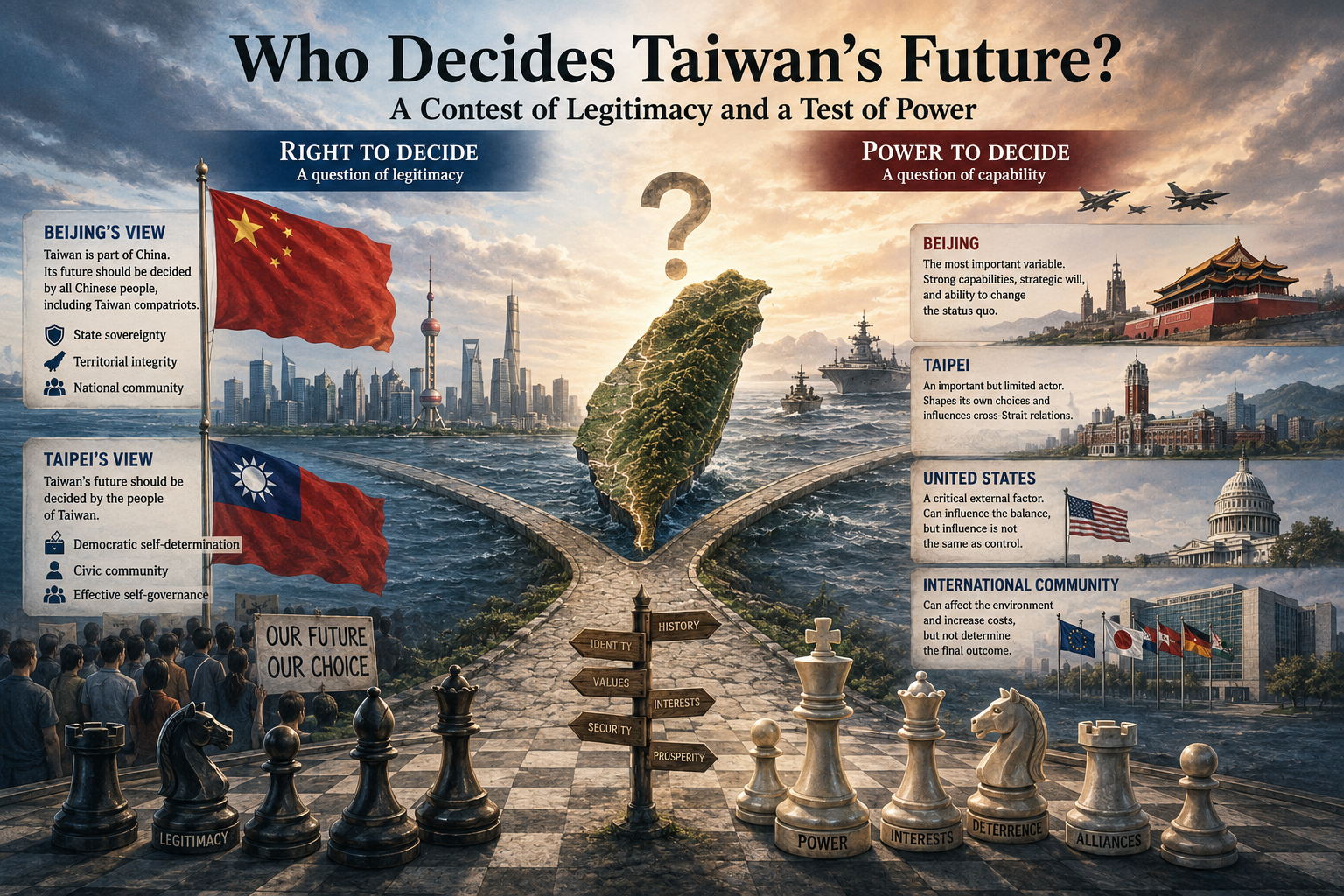
Taipei argues that Taiwan’s future should be decided by the people of Taiwan. Beijing, by contrast, maintains that Taiwan is part of China and that its future should be determined by all Chinese people, including the people of Taiwan.
Both sides regard their position as self-evident and believe the other overlooks fundamental political principles. Yet a closer examination reveals that people are actually debating two different questions:
Who has the right to decide Taiwan’s future?
Who has the power to decide Taiwan’s future?
The first concerns legitimacy and political principles, while the second concerns capability, strategic will, and the realities of power politics.
To understand the Taiwan issue, one must address both questions.
I. Who Has the Right to Decide Taiwan’s Future?
This is fundamentally a question of legitimacy. On this issue, Beijing and Taipei represent two different political logics.
1. Beijing’s Position: The Chinese People as a Whole Have the Right to Decide
Beijing’s position is clear and consistent. According to the long-standing policy of the Chinese government, Taiwan is an inseparable part of China, and the Taiwan issue is an internal matter of China.
Under this framework, Taiwan’s future concerns not only the people living on the island, but also China’s national unity, territorial integrity, and broader national interests.
Therefore, Beijing argues that Taiwan’s future cannot be determined solely by the residents of Taiwan.
From Beijing’s perspective, allowing Taiwan alone to decide its political status would effectively grant it the authority to determine the territorial boundaries of the Chinese state—an outcome fundamentally incompatible with the principle of national reunification.
At the core of this position lie the concepts of state sovereignty and territorial integrity.
2.Taipei’s Position: The People of Taiwan Have the Right to Decide
A different argument is rooted in the principle of democratic self-determination.
Supporters of this position contend that the people who live in Taiwan bear the direct consequences of war and peace, prosperity and risk.
Therefore, they argue, Taiwan’s future should be decided by Taiwan’s residents themselves.
This perspective emphasizes a contemporary political community rather than a historical national community.
In this logic, political authority derives from lived experience, democratic participation, and civic identity.
Those who live on the island, pay taxes, vote, and bear the consequences of public policy should possess the ultimate right to determine their future.
As a result, the principle that “Taiwan’s future should be decided by the people of Taiwan” has become a central political proposition for many political forces on the island.
3. Two Narratives, Two Logics
It is important to recognize that the disagreement between Beijing and Taipei is not simply a matter of right versus wrong.
Rather, the two sides are operating from different political principles.
Beijing emphasizes state sovereignty, territorial integrity, and a broader national community.
Taipei emphasizes democratic self-determination, civic identity, and effective self-governance.
The challenge is that both sets of principles exist within modern international politics.
The unification of Germany and Vietnam reflected the principle of national unity, while the independence of East Timor and South Sudan reflected the principle of self-determination.
International law does not provide a single universal formula capable of resolving every dispute of this kind.
Viewed from the perspective of legitimacy, the Taiwan issue is therefore a competition between different claims of political authority.
People reach different conclusions because they prioritize different values.
This helps explain why decades of debate have failed to persuade either side.
II. Who Has the Power to Decide Taiwan’s Future?
If legitimacy belongs to political philosophy, power belongs to political reality.
History shows that many major international disputes are not ultimately resolved according to the most morally persuasive argument. Instead, they evolve within the limits established by power structures.
For this reason, the international community often pays as much attention to who can shape outcomes as to who should shape them.
1.Beijing as the Most Important Variable
From the perspective of practical capability, Beijing is undoubtedly the most important actor influencing Taiwan’s future. The reasons are straightforward.
First, Beijing possesses significant initiative in cross-Strait policy. Whether maintaining the status quo, increasing pressure, promoting integration, or adopting more forceful measures, Beijing commands resources and instruments of power that exceed those of other participants.
Second, Beijing defines national reunification as a core national interest.
In international politics, the importance of an issue is often measured by the costs a state is willing to bear in pursuit of its objectives.
For Beijing, Taiwan is not merely a diplomatic issue. It is closely linked to national unity, political legitimacy, and the broader narrative of national rejuvenation.
This strategic priority gives Beijing a high degree of policy consistency and long-term commitment.
Most importantly, Beijing possesses the capability to alter the status quo in the Taiwan Strait.
Regardless of how different observers evaluate that reality, it remains a central fact of contemporary geopolitics.
2.Taipei’s Significant but Limited Influence
Taiwan is not merely a passive object in this process. It possesses its own political institutions, economic strength, and evolving social identity.
Taiwan’s voters choose their leaders and influence cross-Strait policy through democratic elections.
Without the choices made by Taiwanese society itself, cross-Strait relations would not have developed as they have.
Taiwan is therefore both a participant in and a subject of the Taiwan issue.
However, Taiwan’s influence is primarily expressed through shaping its own choices rather than unilaterally determining the final outcome.
In disputes involving sovereignty and strategic competition, smaller political entities often face constraints that limit their ability to determine outcomes independently.
3.The United States as a Critical External Factor
Any discussion of Taiwan’s future must also consider the role of the United States.
For decades, Washington has been the most influential external actor affecting the strategic balance in the Taiwan Strait.
Through military, diplomatic, and economic means, the United States exerts considerable influence on regional security dynamics.
From a practical standpoint, Washington can raise the costs of action for Beijing and strengthen Taiwan’s confidence in its security environment.
The United States therefore possesses substantial capacity to influence Taiwan’s future.
Influence, however, is not the same as control.
For Washington, Taiwan represents an important strategic interest.
For Beijing, Taiwan is defined as a core national interest.
A long-standing observation in international relations holds that when a core interest confronts an important interest, the actor defending the core interest often demonstrates greater strategic determination.
Consequently, the United States can shape the future of Taiwan, but it may not be able to determine it.
4. The International Community Can Influence, but Not Direct, the Outcome
Europe, Japan, and many other countries closely monitor developments in the Taiwan Strait.
Through diplomacy, economic policies, and public messaging, they can affect the broader environment in which decisions are made.
Yet these actors generally function as contextual variables rather than decisive ones.
International opinion can increase political costs, but it rarely compels major powers to abandon what they perceive as vital national interests.
This pattern has been repeatedly observed in international crises throughout modern history.
III. The Most Dangerous Misconception
One of the most common mistakes in discussions about Taiwan’s future is to assume that possessing the right to decide automatically means possessing the ability to decide.
In fact, the two are not the same.
Believing one has legitimacy does not guarantee success.
Possessing power does not automatically confer legitimacy.
Many international conflicts arise precisely because legitimacy and capability do not align.
When one side believes it possesses an unquestionable right while another possesses the ability to alter reality, tensions tend to intensify.
The Taiwan issue reflects this dynamic.
Beijing emphasizes the legitimacy of national reunification.
Taipei emphasizes the legitimacy of democratic self-determination.
Both possess coherent narratives and substantial support.
The problem is that they define legitimacy in fundamentally different ways.
IV: Conclusion
Who decides Taiwan’s future?
From the perspective of legitimacy, there is no internationally accepted consensus.
Beijing and Taipei have developed competing frameworks of political legitimacy, each grounded in its own historical experiences and theoretical foundations.
From the perspective of capability, however, the answer is somewhat clearer.
Beijing, Taipei, Washington, and the broader international environment all influence Taiwan’s future, but they do not influence it equally.
Beijing remains the most consequential actor.
Taipei is an important participant.
Washington is the most significant external power.
The international community provides the broader strategic context.
Taiwan’s future is therefore neither purely a legal question nor purely a military one.
It is the product of legitimacy and power, history and reality, principles and capabilities interacting simultaneously.
Understanding this complexity may be more important than simply choosing sides. Because in international politics, history is often shaped not only by who believes they are right, but also by who understands both the logic of their opponents and the structure of power within which all actors must operate.
Bi Yantao is a professor of communication studies whose research focuses on international communication, international conflict, and peace studies. The views expressed in this article are solely those of the author and do not represent the positions of any affiliated institution.