Abstract: This article examines and challenges the implicit assumption in a recent The New York Times commentary that China has formed a unified perception of the United States as a declining power. It argues that Chinese views of America are far more diverse and internally contested than many external narratives suggest. While some Chinese scholars, commentators, and policy elites believe the United States is experiencing structural decline, others continue to view America as possessing enduring strengths in innovation, finance, institutional resilience, and global influence. The article further contends that both China and the United States are increasingly vulnerable to “cognitive simplification” — the tendency to reduce complex societies into singular strategic identities. It concludes that such simplification may itself become a strategic risk in contemporary international relations, narrowing the space for mutual understanding and increasing the potential for miscalculation.
Key Words: American Decline Debate, Cognitive Simplification, international communication, Strategic Perception, US-China Relations
By BI Yantao
May 12, 2026
Recently, The New York Times published an opinion article titled Trump Is Coming to a China That Has Moved On, which implicitly advances an important proposition: that China increasingly views the United States as a “declining power.”
This observation is not entirely unfounded.
Over the past decade, narratives about “American decline” have become increasingly common in Chinese online discourse, parts of academia, and strategic studies circles. Especially after the global financial crisis, the withdrawal from Afghanistan, rising political polarization, mounting debt, and the “Trump phenomenon,” arguments about a “crisis of the American system” have gained broader traction in China. The phrase “the East is rising while the West is declining” has become one of the most recognizable expressions of this sentiment. Yet such views do not mean that China has reached a unified internal consensus about America’s future.
To conclude from this, however, that “China has formed a unified perception of American decline” risks oversimplifying the country’s far more complex and internally diverse cognitive landscape. The issue is not merely whether the United States is declining, but who gets to define how “China” sees America.
“China Thinks” Is Not a Simple Proposition
When discussing China, Western media often unconsciously employ what might be called a “single-subject narrative”, such as “China believes,” “Beijing thinks,” “China sees the United States as,” “China is preparing for”.
Such formulations are common in journalism, but they often obscure an important reality: China is not a cognitively homogeneous community. Particularly regarding perceptions of the United States, substantial differences have long existed within China.
One school of thought argues that the United States is entering a phase of structural decline.
Those who hold this view typically emphasize intensifying political polarization, growing social fragmentation, deindustrialization, unsustainable fiscal deficits and debt, declining global governance capacity, the rising costs of alliance maintenance, challenges to dollar hegemony, and the weakening appeal of liberal Western narratives.
In their view, America’s problem is not imminent collapse, but the increasing cost of sustaining global hegemony. This assessment aligns in many ways with the logic of “hegemonic decline” in international relations theory.
China Also Has a Strong “America Remains Powerful” Camp
At the same time, another markedly different perspective has long existed within China.
A number of strategic analysts, business leaders, and intellectuals do not accept the conclusion that the United States is undergoing irreversible decline.
They argue that despite America’s serious internal problems, its deep structural advantages remain extraordinarily strong, including the world’s leading innovation ecosystem, elite universities and research networks, dominance of the dollar and global financial system, a powerful alliance structure, the ability to attract top global talent, advantages in AI, semiconductors, biotechnology, and other frontier sectors, and strong institutional self-correction mechanisms.
From this perspective, the United States is experiencing a cyclical adjustment rather than a civilizational decline.
This group is particularly wary of one strategic danger: mistaking America’s temporary disorder for irreversible long-term decline.
Historically, the United States has repeatedly been predicted to decline — during the rise of Japan in the 1970s, after the Vietnam War, and following the 2008 financial crisis. Yet each time, the United States demonstrated a significant capacity for reorganization and adaptation.
For these observers in China, the most important thing about America is not its problems, but its resilience.
China and the United States Are Both Misreading Each Other
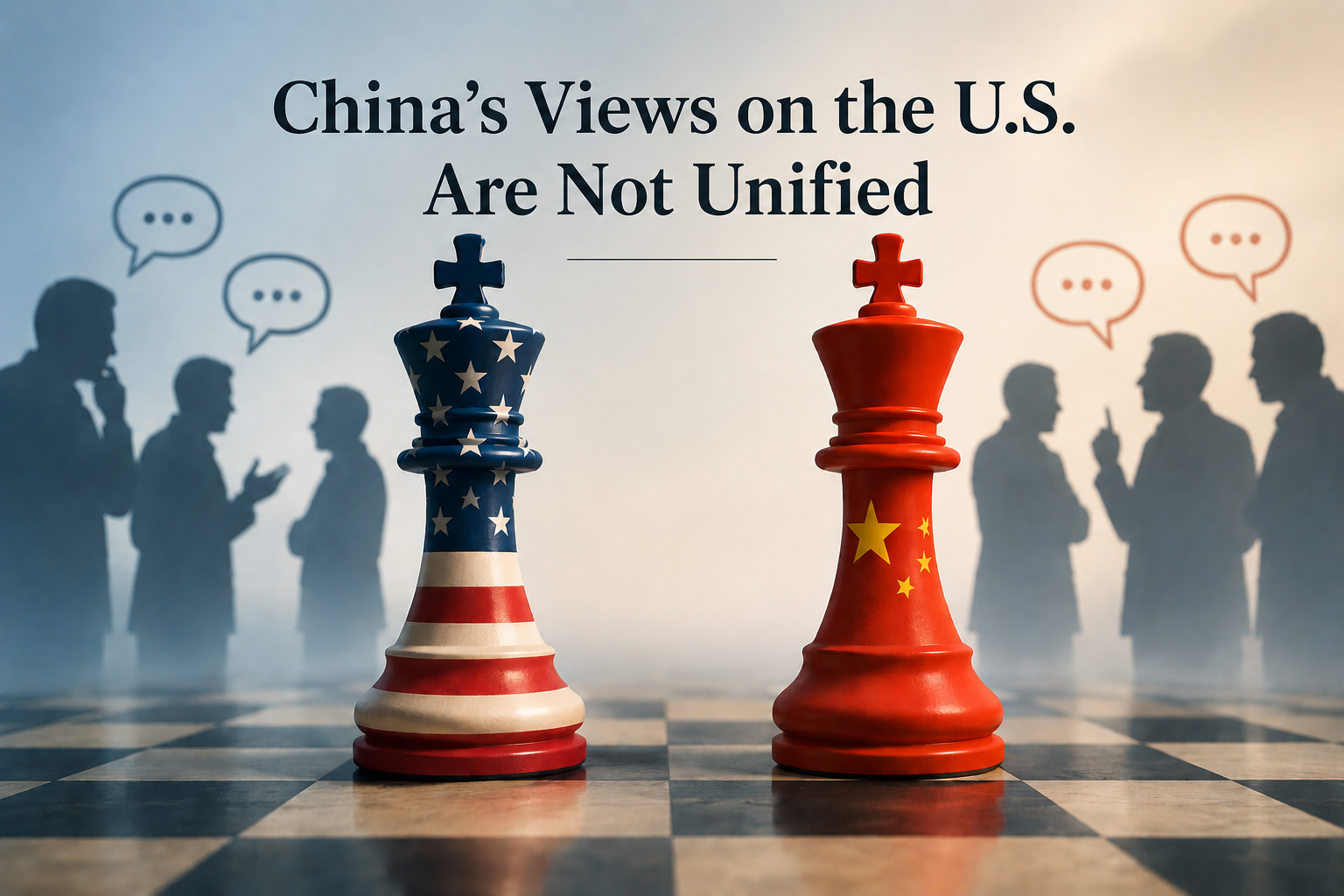
What deserves greater attention is that China has not formed a unified “American decline consensus,” just as the United States has not formed a unified “China rise consensus.”
In recent years, the American strategic community has also displayed deep divisions:
some believe China is steadily rising; others argue that China has already peaked; some foresee long-term economic stagnation in China; others still view China as possessing enduring systemic competitiveness.
In other words, both China and the United States are attempting to interpret each other while failing to reach stable internal consensus themselves.
This suggests that one of the greatest risks today may not be confrontation itself, but cognitive simplification — and the media play a major role in this process.
When a complex, multilayered China with substantial internal disagreements is compressed into a singular strategic actor, the outside world is more likely to develop the illusion that “China unanimously believes America is declining.”
Reality is far more complicated.
The “American Decline” Narrative May Itself Become a Strategic Risk
Historically, one of the most dangerous moments in international politics occurs when one major power believes another is declining while that power still retains enormous capabilities.
A “declining power” is not necessarily a safer power. In some cases, it may become more sensitive, more reactive, and more determined to defend the existing order. Similar cognitive structures appeared historically between Germany and Britain, and between Japan and the United States.
This is partly why the phrase “declining but dangerous” has become increasingly common in American strategic discourse.
In fact, many within China’s strategic community hold a similar view. They argue that the real question is not whether America is declining, but whether it is willing to accept relative decline.
Therefore, the most important issue today may not be whether America is declining, but whether China and the United States are developing increasingly rigid and deterministic perceptions of each other.
Once such judgments become ideological, emotionalized, and heavily mediated, the space for genuine mutual understanding may continue to shrink.
Cognitive Complexity Matters More Than Emotional Judgment
The New York Times article captures certain real emotional and cognitive shifts within Chinese society. But its problem lies in the impression it may leave on outside audiences: that China has already formed a unified, stable, and definitive consensus regarding American decline.
In reality, Chinese perceptions of the United States are far more diverse than many outsiders assume.
Some believe America is declining. Some believe it remains the world’s strongest country. Others believe America is both declining and still dangerous. These differences themselves demonstrate that China is not a single-track cognitive community.
In international communication, an increasingly important question is this: Are we trying to understand the real “other,” or are we continuously constructing a simplified image of the other?
That question may ultimately matter more than whether America is declining.
BI Yantao is Professor at the School of International Communication and Arts, Hainan University, China and Senior Research Fellow at the Charhar Institute. The views expressed here are solely those of the author and do not represent the positions of affiliated institutions.