Abstract
This essay explores the cognitive and perceptual divergence between China and the West regarding the Russia–Ukraine war. While the dominant Western narrative frames the conflict primarily through the lens of violated sovereignty, the inviolability of international rules, and Russian aggression, many in Chinese society interpret it through the prism of security dilemmas, strategic encirclement, and great-power power politics. Drawing on China’s modern historical experience of external pressure and containment, the author argues that Chinese skepticism toward the Western account stems not merely from information itself, but from fundamentally different civilizational frameworks for understanding international politics. The essay contends that the war represents a global contest over the “right to define reality,” revealing a fragmented international cognitive order in which different civilizations interpret the same events through distinct historical memories and security logics. Rather than seeking universal persuasion, the author advocates for mutual recognition of differing narratives as essential for meaningful cross-civilizational communication in an increasingly multipolar world.
Keywords: Russia–Ukraine war, China-West perceptual divergence, civilizational narratives, security dilemma,, cross-civilizational communication
By Bi Yantao
Published on May 27, 2026
Since the outbreak of the Russia–Ukraine war, a persistent question has puzzled much of Western public opinion: why do a considerable number of Chinese citizens — including many highly educated elites familiar with international affairs — not fully accept the dominant Western narrative surrounding the conflict?
Within mainstream Western discourse, the answer is often simplified as a matter of “propaganda,” “information control,” or “differences in media environments.” Yet such explanations themselves reveal a limited understanding of the cognitive structure of Chinese society.
One unavoidable reality is this: even among Chinese individuals who have long been exposed to Western media and possess substantial international awareness, many still remain skeptical of the Western interpretation of the war. This suggests that the issue is not merely about access to information. At a deeper level, it concerns fundamentally different civilizational understandings of international politics.
The Russia–Ukraine war is not only a military conflict. It is also a global cognitive struggle over the “right to define reality.”
I. The Logical Foundation of the Western Narrative
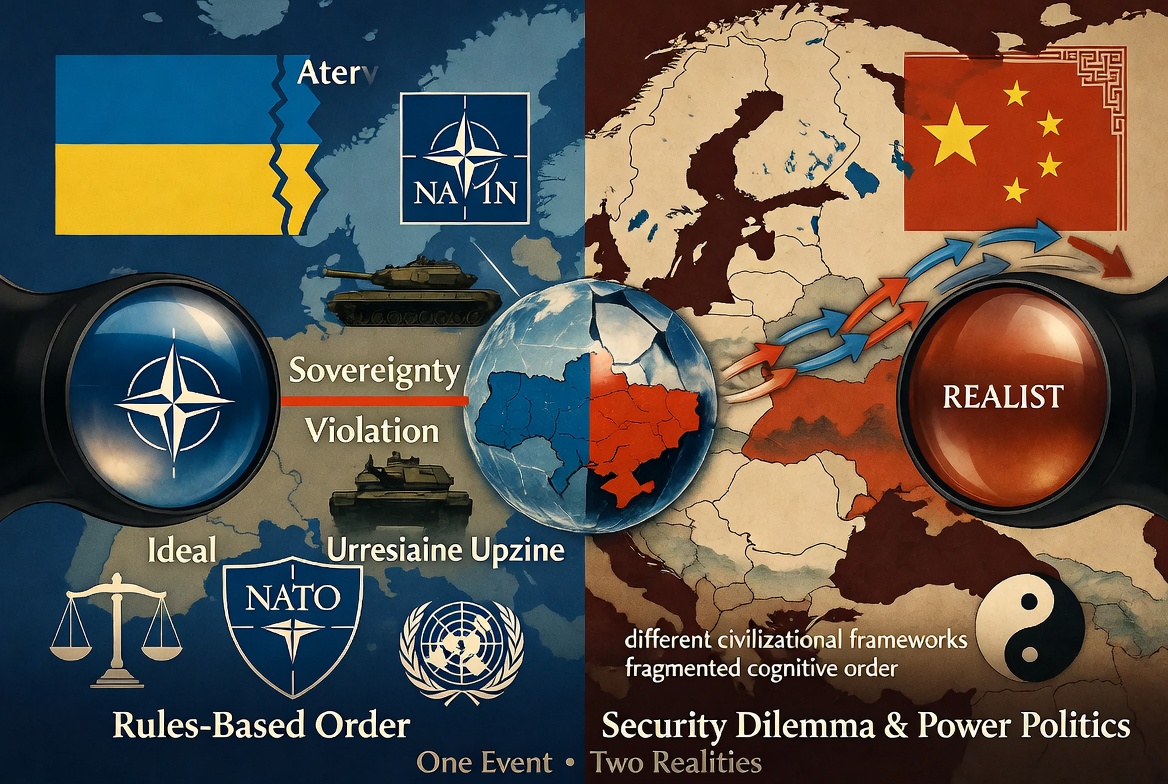
The dominant Western narrative surrounding the Russia–Ukraine war is broadly built upon several core principles.
First, national sovereignty is inviolable. Russia’s military entry into Ukrainian territory is therefore defined as aggression against a sovereign state.
Second, smaller nations possess the right to independent choice. Ukraine is considered fully entitled to determine its own diplomatic and security arrangements, including whether to join NATO.
Third, alliance expansion is not equivalent to aggression. NATO enlargement is framed as the voluntary choice of member states seeking security, rather than an offensive act against Russia.
Fourth, international rules take precedence over geopolitical logic. No country, according to this view, may alter internationally recognized borders on the basis of “security concerns.”
From the perspective of the modern Western international order, this logic possesses considerable internal consistency. As a result, within Western societies, this narrative carries strong moral legitimacy.
The problem, however, is that these assumptions are not rooted in the shared historical experience of all civilizations.
II. Why Chinese Society Feels Distant from the Western Narrative
Many Chinese people do not necessarily endorse war, nor do they necessarily support Russia’s military actions. Yet they often remain skeptical toward certain underlying assumptions embedded in the Western narrative.
The reason lies in the different historical experiences that have shaped Chinese society.
Since the modern era, China’s collective historical memory has been deeply marked by external encirclement, suppression, and foreign intervention. Whether through the imperialist system of the nineteenth century, Cold War containment structures, or contemporary technological restrictions and geopolitical competition, Chinese society has become highly sensitive to concepts such as “security pressure,” “strategic encirclement,” and “external containment.”
As a result, many Chinese observers approach the Russia–Ukraine conflict not primarily as a question of sovereignty, but as a question of whether continuous NATO expansion has gradually compressed Russia’s strategic security space.
For many Chinese people, international politics is not simply a legal issue. It is also a structural issue of power and security.
In other words, Western societies tend to interpret the war through the lens of rules, while many in Chinese society interpret it through the lens of security structures. This is one of the central sources of cognitive divergence between the two sides.
III. What Many Chinese Accept Is Not Russia, but a “Security Logic”
Western discourse often assumes that any understanding of Russia’s narrative within Chinese society necessarily reflects support for the war itself.
In reality, what many Chinese people recognize is not the war, but a certain logic of security anxiety.
That logic can be summarized as follows: if a country perceives its strategic security space as being continuously compressed over a long period of time, it may eventually respond in increasingly radical ways.
This mode of thinking reflects a fundamentally realist security intuition.
Importantly, this intuition does not exist only in Russia. For a Chinese society shaped by memories of national humiliation and prolonged external pressure, such a security logic resonates psychologically.
Therefore, Chinese perceptions of the Russia–Ukraine war are often less about being “pro-Russia” and more about recognizing the reality of security dilemmas in international politics.
IV. What the West Truly Struggles to Understand: Different Civilizations Generate Reality Differently
A deeper misconception within Western discourse is the tendency to assume that its own narrative possesses universal validity.
In reality, human beings do not perceive reality directly. They interpret reality through civilizational frameworks developed through history.
The same war therefore produces entirely different meanings across different societies.
The West sees “aggression.”
Russia sees “strategic defense.”
Many Chinese see a “great-power security conflict.”
Many countries in the Global South see another manifestation of the long-standing structural imbalance between Western and non-Western power.
In other words, different civilizations are not simply observing the same reality from different angles. They are interpreting reality through fundamentally different historical experiences.
This may be the deepest problem in international communication today.
V. Behind the Russia–Ukraine War Lies a Fragmentation of the Global Cognitive Order
After the Cold War, the West once believed that the liberal international order possessed universal legitimacy.
Yet the Russia–Ukraine war has exposed a different reality: the world has not developed a unified cognitive system.
For many non-Western societies, international rules are not viewed as entirely neutral. They are often seen as deeply intertwined with existing power structures. Even so-called “universal values” may carry the imprint of specific civilizational experiences.
As a consequence, an increasingly visible phenomenon is emerging across the globe: different civilizations are forming different “systems of reality interpretation.”
The greatest danger is not disagreement itself. The greatest danger is that societies are gradually losing the ability to understand why others perceive the world differently.
Once one side assumes that its own narrative represents universal truth, while dismissing the other side’s historical experiences, security anxieties, and cognitive structures as mere “propaganda,” genuine cross-civilizational communication becomes increasingly difficult.
VI. The Future of International Communication: Not Persuasion, but Mutual Recognition of Narratives
The central challenge of future international communication may no longer be “who communicates more effectively,” but whether different civilizations can still preserve the capacity to understand one another.
Cross-civilizational dialogue does not require abandoning one’s own values, nor does it require agreeing with opposing positions.
But it does require acknowledging at least this much:
Different nations possess real historical experiences.
Different civilizations possess real security anxieties.
Different societies possess genuinely different understandings of international order.
If even this basic recognition disappears, international communication may ultimately devolve into endless collisions between parallel narratives.
And perhaps that is the deepest lesson the Russia–Ukraine war has revealed to the world.
(With gratitude for the deep discussions between ChatGPT and myself. This cross-framework dialogue allowed me to reexamine the structure of my own thinking, and I benefited greatly from the process.)
Bi Yantao is Professor at the School of International Communication and Art, Hainan University, and a Senior Research Fellow at the Charhar Institute. The views expressed in this article are solely those of the author and do not represent the positions of any affiliated institutions.