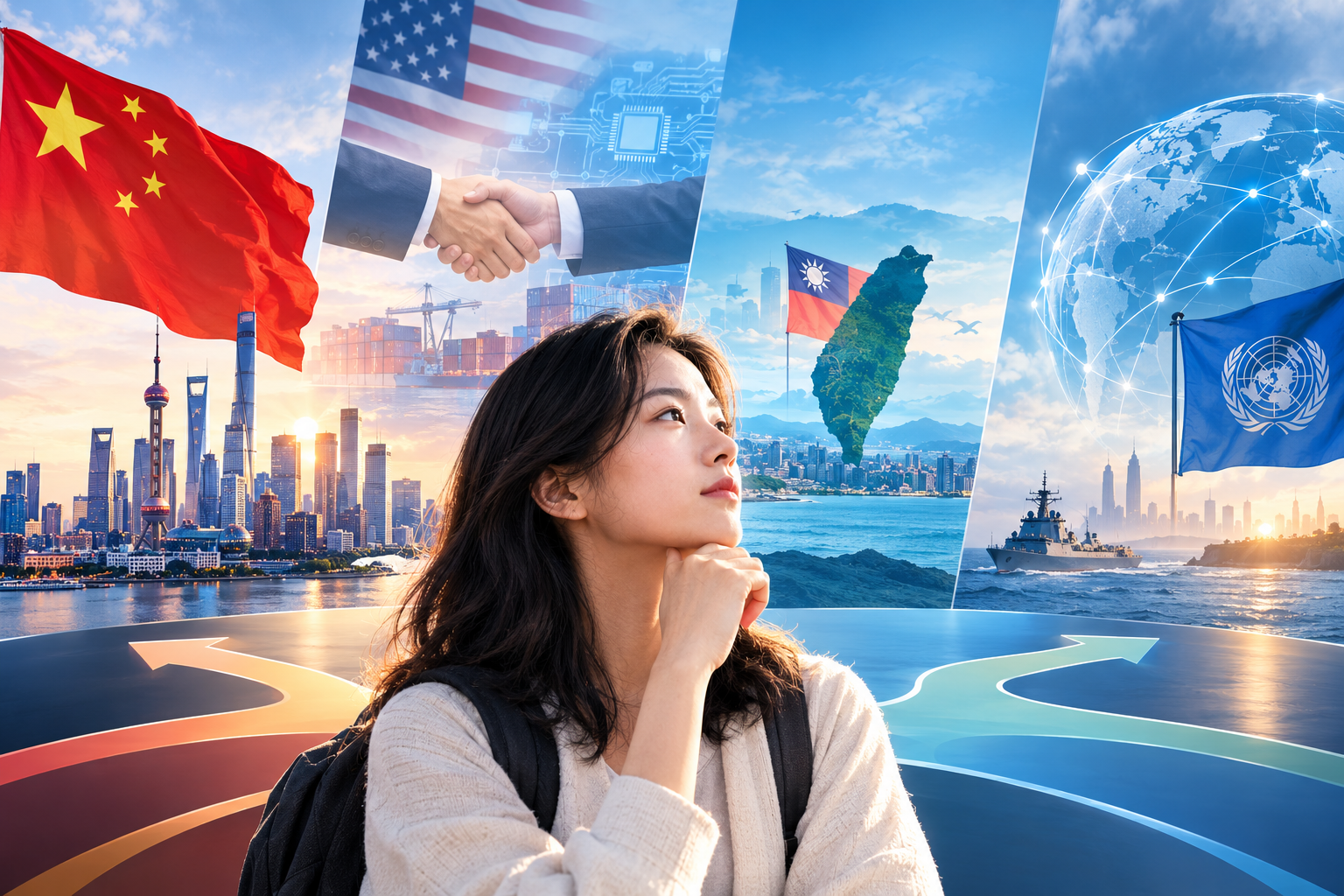
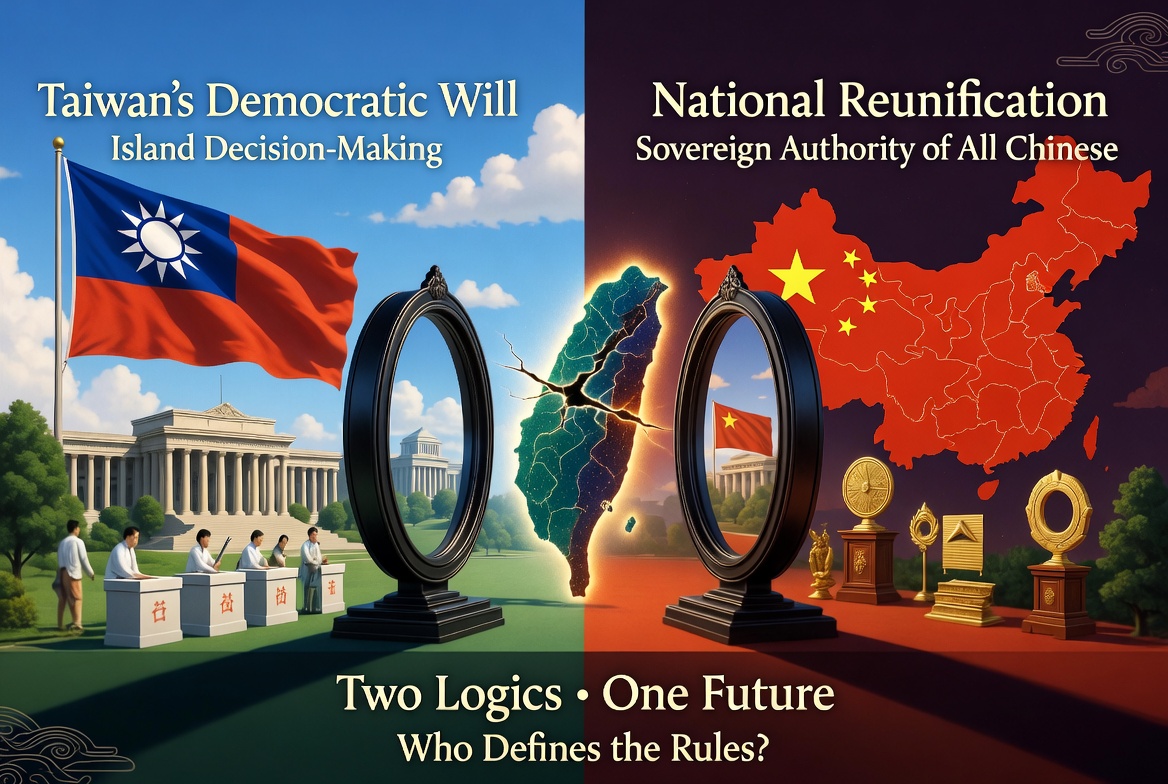
The debate over Taiwan’s future appears, on the surface, to concern “who gets to decide.” In reality, however, it is fundamentally a struggle over who has the authority to define the rules themselves. Both narratives possess their own internal logic, but their ultimate influence depends on shifts in power realities and geopolitical circumstances.
By Bi Yantao
Published on May 27, 2026
I. This Question Is Actually Asking Two Completely Different Things
At first glance, “Who decides Taiwan’s future?” seems to be a political question. In reality, however, there are at least two fundamentally different ways to answer it.
One argument holds that Taiwan’s future should be decided by Taiwan society itself.
The other argues that the Taiwan issue concerns national unity, and therefore should ultimately be decided collectively by all Chinese people, including those in Taiwan.
Both narratives speak in the name of “the people,” but the crucial difference lies in who is counted as “the people,” and who has the authority to serve as the final arbiter.
II. The DPP/Taipei Narrative: Emphasizing “Decision-Making Within the Island”
Taking the current ruling forces in Taiwan as an example, the core logic is relatively straightforward:
Taiwan is a society with an established and stable political system; therefore, its future should be determined through elections, public opinion, and institutions within the island.
Under this logic, political leadership is decided by votes, policy direction by domestic political competition, and external actors may influence developments but cannot “determine” them.
The essence of this narrative is to confine decision-making authority within Taiwan’s own political community.
III. Beijing’s Narrative: Emphasizing “Overall Sovereign Authority”
From Beijing’s perspective, the Taiwan issue is not merely a matter of local governance, but one concerning national sovereignty and territorial unity.
Accordingly, its central logic is that Taiwan’s future cannot be decided “separately,” because Taiwan is part of China’s overall national structure.
In other words, Taiwan is not regarded as a fully independent decision-making unit. Its ultimate direction must be understood within the framework of national reunification. The views of the Taiwanese people matter, but they are not considered the sole source of decision-making authority.
The key point of this logic is that the political community entitled to decide is larger than the island itself.
IV. The Real Conflict Between the Two Narratives: Not Views, but “Rules”
Many people mistakenly believe this is merely a dispute between two political viewpoints. In reality, it is not.
The true conflict concerns who has the authority to define the rules of the game.
One side argues that elections within Taiwan should determine everything.
The other insists that the rules are defined by the framework of national unity and sovereignty.
This is not a competition within the same set of rules. It is a struggle over the rules themselves.
V. A Practical Question: What Ultimately Allows These Narratives to Become Reality?
If narratives remain only rhetorical expressions, they remain merely narratives.
In real-world politics, however, whether a narrative can prevail depends on three factors:
First, whether it can be transformed into institutions — laws, policies, and organizational capacity.
Second, whether it can translate into concrete actions — elections, diplomacy, military arrangements, and security structures.
Third, whether it can be accepted by, or impose adaptation upon, the external environment.
This is where external variables — such as U.S. involvement, global supply chains, and international public opinion — become relevant. These factors do matter, but they do not operate in the same way.
VI. A More Realistic Assessment: The Weight of Variables Is Not Fixed
Under normal political conditions, factors such as economics, public opinion, and industrial dependence carry considerable importance. However, when issues are perceived as core national interests by major powers, the role of these variables changes.
They often cease to determine whether action will be taken. Instead, they shape the cost of taking action.
In other words, under ordinary conditions, these factors influence decision-making itself. Under high-pressure conditions, however, they influence cost calculations rather than strategic direction. This distinction is frequently misunderstood.
VII. The Real Key: When Does the Situation Shift Into a Different Mode?
At its core, the Taiwan issue is not a stable game, but a structure capable of shifting between different modes.
Under conditions of low confrontation, the competition centers more on politics, elections, economics, and public opinion.
Under conditions of high confrontation, sovereignty logic becomes the dominant rule with higher priority.
This means that the answer to “who matters more” changes depending on the situation.
VIII. Conclusion: It Is Not About Who Decides Forever, but Who Decides Under Which Conditions
Ultimately, the issue can be summarized in one sentence:
Taiwan’s future is not permanently determined by any single actor. Rather, different levels of power assume dominance under different circumstances.
Put more directly: Domestic politics within Taiwan shape day-to-day direction; the framework of national sovereignty defines the ultimate boundaries; and external powers influence the costs and strategic space surrounding the process.
The core dispute is not whether any side possesses “decision-making authority,” but rather who holds the final power to decide when critical conditions change. This is the point at which the two narratives become fundamentally irreconcilable.
Bi Yantao is Professor at the School of International Communication and Art, Hainan University, and a Senior Research Fellow at the Charhar Institute. The views expressed in this article are solely those of the author and do not represent the positions of any affiliated institutions.