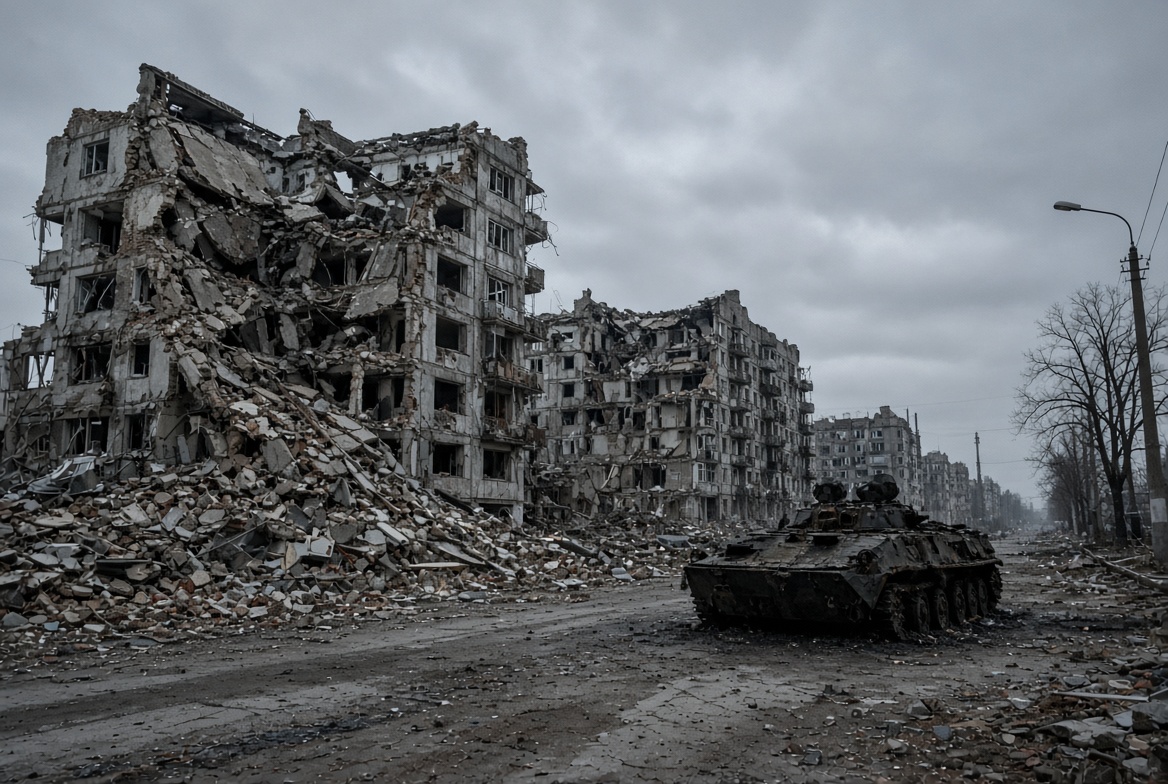
The Russia–Ukraine war has lasted more than four years. The battlefield continues to evolve, and both sides are seeking military breakthroughs. Yet, viewed in the context of the war as a whole, one clear judgment can be made: the Russia–Ukraine war will ultimately end through negotiations, rather than with one side defeating the other militarily. This is not a prediction of when the war will end, but an assessment of the nature of its eventual outcome.
By Bi Yantao | October 9, 2026
1. Russia Is Unlikely to Defeat Ukraine Completely
Russia possesses greater strategic resources and stronger war-mobilization capabilities. However, the prolonged conflict has demonstrated that military superiority does not necessarily translate into the rapid achievement of political objectives.
Although Ukraine faces pressure in terms of manpower, equipment, and public finances, it remains capable of sustaining its resistance and continues to receive support from European countries and others. The United Kingdom has so far committed £25 billion in support for Ukraine, including £16 billion in military assistance.
Russia may therefore continue to advance on the battlefield and intensify its attacks, but resolving the Ukraine question entirely through military means remains extremely difficult.
2. Ukraine Is Also Unlikely to Defeat Russia Militarily
Ukraine’s ability to resist does not mean it can ultimately defeat Russia.
Ukraine can continue to raise the costs of the war for Russia through counteroffensives, drones, and long-range strikes. However, fully recovering its lost territory and compelling Russia to accept strategic defeat would require a sustained capacity to achieve strategic breakthroughs. This is fundamentally different from securing localized advantages on the battlefield.
One particularly important consideration is that Russia is not fighting in isolation.
3. The China Factor Means Russia Cannot Easily Be Defeated
China has consistently called for a ceasefire, dialogue, and negotiations over the Russia–Ukraine war. At the same time, economic and technological ties between China and Russia continue to provide Russia with significant strategic depth.
A 2026 report by the U.S.-China Economic and Security Review Commission, a commission established by the U.S. Congress, assesses that China has become an important external pillar of Russia’s wartime economy. According to the report, China’s energy purchases and supplies of dual-use products have helped Russia sustain its economic capacity and defense industrial base. The report also states that China accounted for approximately 90 percent of certain controlled-technology imports received by Russia in 2026. These figures represent assessments by a U.S. institution, and some involve contested intelligence judgments that the Chinese government does not accept.
The central issue here is not whether China is helping Russia, but a broader strategic reality: if Russia faced strategic collapse, China would find it difficult to ignore the resulting changes in the balance of power across Eurasia.
Ukraine is therefore not confronting a Russia that can be weakened indefinitely without wider consequences. Russia retains considerable strategic depth through external relationships and support.
4. North Korea Further Increases Russia’s Capacity to Sustain the War
North Korea has supplied Russia with large quantities of artillery shells, missiles, and military personnel. Research materials published by the UK House of Commons in September this year indicate that North Korea had previously deployed approximately 11,000 troops to Russia and supplied millions of rounds of ammunition. In 2026, Russia and North Korea also continued to advance their long-term military cooperation.
This means that Russia’s ability to wage war does not depend entirely on its own defense-industrial system.
More importantly, relations between Russia and North Korea are becoming institutionalized. The two countries signed a Comprehensive Strategic Partnership Treaty in 2024, and Russia took further steps in 2026 to make their military cooperation more enduring.
North Korea does not need to help Russia win the war. By continuously supplying personnel, ammunition, and certain weapons, it can increase Russia’s capacity to withstand a prolonged war of attrition.
A basic strategic configuration is thus emerging: Ukraine receives support from Europe and other partners, while Russia benefits from various forms of external support, including from China and North Korea.
This makes it increasingly difficult for either side to defeat the other completely through military means.
5. The War Cannot Be Resolved Through Warfare Indefinitely
This is the central logic underlying the eventual outcome of the Russia–Ukraine war.
Russia is unlikely to conquer Ukraine completely, while Ukraine is unlikely to compel Russia to accept strategic defeat. Meanwhile, the external powers supporting each side can, to varying degrees, help sustain their respective capacities to continue fighting.
The battlefield will undoubtedly continue to change.
Russia may make further advances, and Ukraine may launch new counteroffensives. Drone attacks, missile strikes, and long-range operations may intensify. But changes on the battlefield do not necessarily mean that the war can ultimately be resolved through military means.
The longer the war continues, the greater the human, fiscal, and social costs for both sides. The pressure on Europe’s security architecture will also increase. Eventually, all parties will have to confront a fundamental reality: continued fighting can change the negotiating leverage of the parties, but it may not change the ultimate outcome of the war.
On October 8, U.S. Secretary of State Marco Rubio described the war as a “dangerous stalemate” and said that a lasting solution needed to be pursued through negotiations.
This does not mean negotiations will begin immediately. It does, however, suggest that negotiations are once again emerging as a mechanism for ending the war, rather than merely as a last resort after military failure.
6. The United States Is Best Positioned to Promote Negotiations, but a Five-Party Framework Is Needed
The United States is the actor most likely to take the lead in bringing Russia and Ukraine back to the negotiating table. Washington has considerable influence over Ukraine and maintains channels for direct communication with Moscow.
However, a negotiating process involving only the United States, Russia, and Ukraine may not be sufficient to establish a stable European security order. China and Europe should also be included in the framework.
A possible approach would therefore be to establish a five-party mechanism involving the United States, Russia, Ukraine, China, and the European Union.
The purpose of this mechanism should extend beyond determining the location of a ceasefire line. It should also address territorial issues, security guarantees, sanctions, reconstruction, arms control, and the broader security order across Eurasia.
Under such an arrangement, the United States could take the lead in facilitating negotiations; Russia and Ukraine would negotiate directly with each other; China could play an important mediating role; and Europe would participate directly in decisions concerning its own security.
This approach would more closely reflect the actual structure of the war than a narrowly defined Russia–Ukraine peace negotiation.
Conclusion
The Russia–Ukraine war is no longer simply a bilateral conflict between Russia and Ukraine. Support from the United States and Europe affects how long Ukraine can continue fighting, while China, North Korea, and other factors influence the degree of military pressure Russia can withstand.
For this very reason, both sides retain the capacity to continue fighting, yet neither appears to possess the conditions necessary to resolve the conflict completely through military means.
The Russia–Ukraine war will ultimately end through negotiations. A five-party mechanism may be the institutional framework required to bring about that outcome.
Bi Yantao is a Chinese professor of communication whose principal research interests include international communication, international conflict, and peace. The views expressed in this article are solely those of the author and do not represent the position of any institution with which he is affiliated.