
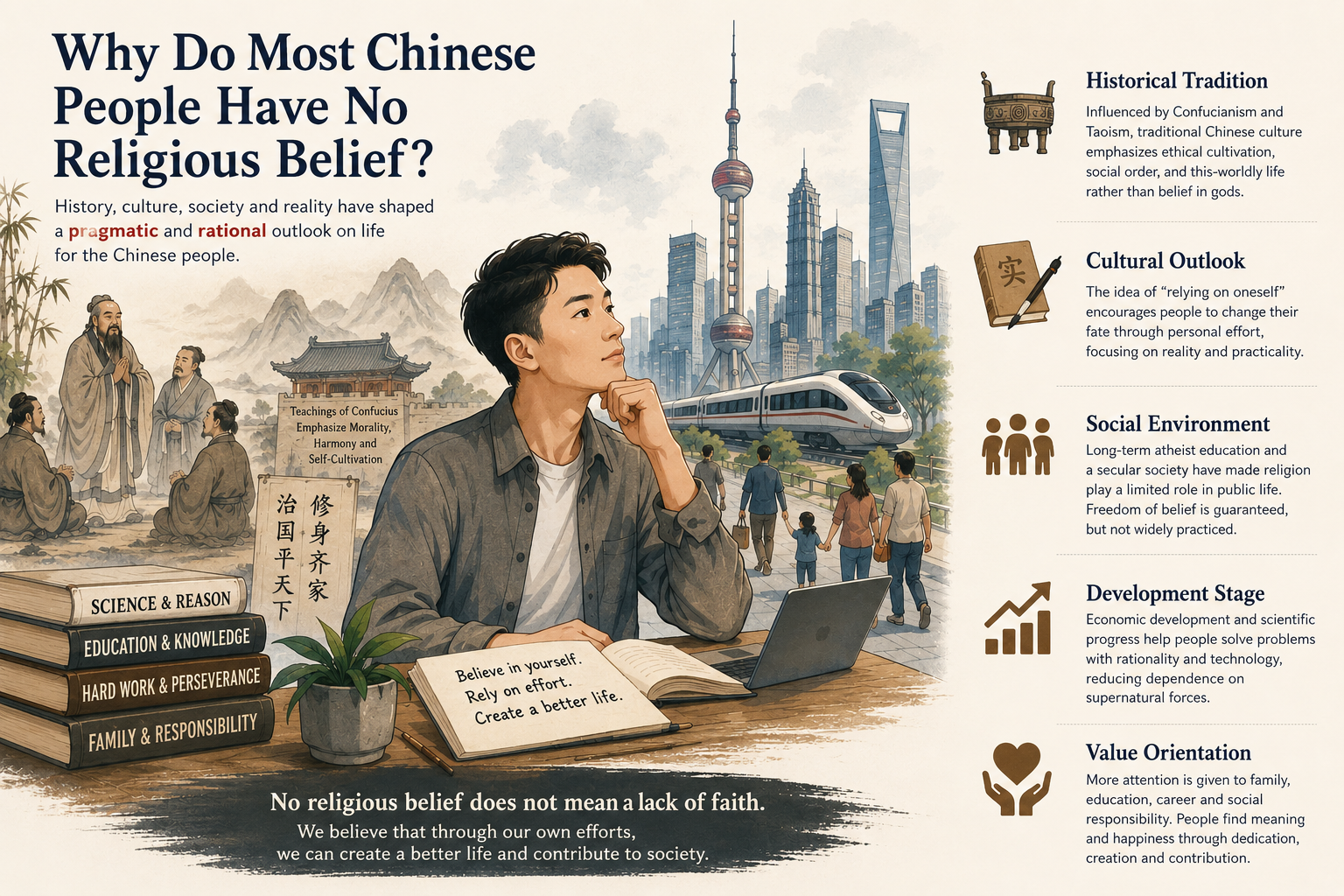
Abstract: This article examines why China has one of the world’s largest populations without formal religious affiliation. Drawing on official Chinese statistics, academic surveys, and international research data, it argues that China’s high level of secularization is rooted not only in modernization and atheist education, but also in the long-term structure of Chinese civilization itself. Unlike many Western societies centered on theology and organized religion, Chinese culture—particularly Confucianism—has historically emphasized secular ethics, family responsibility, and social order. The article further argues that Chinese society is not truly “without belief,” but instead possesses a distinctive spiritual structure characterized by weak institutional religion and strong secular moral culture.
Keywords:China; religion; secularization; family ethics; atheism
By Bi Yantao Published on May 22, 2026
For a long time, China has been regarded as one of the most secularized major countries in the world. Compared with highly religious societies such as the United States, the Middle East, and Latin America, the proportion of people with formal religious affiliations in China is significantly lower. Although statistics vary depending on methodology, the core conclusion remains remarkably consistent: the overwhelming majority of Chinese people do not possess a clear, stable, and institutionalized religious identity.
However, “having no religious belief” does not mean that Chinese people lack a spiritual world. In fact, China has developed a highly distinctive civilizational structure. It differs both from Western monotheistic societies and from a completely non-believing society. Instead, it is a civilization centered on secular ethics, family culture, and pragmatic realism.
I. Data Consensus: China Has the World’s Largest Population Without Formal Religious Identity
Data from Chinese official sources, academic research, and international institutions all indicate that the phenomenon of “no formal religious affiliation” is highly prominent in Chinese society.
1. Official Data: About 86% of the Population Has No Formal Religious Identity
In 2018, the State Council Information Office of China released the white paper China’s Policies and Practices on Protecting Freedom of Religious Belief, stating that China had approximately 200 million religious believers. At the time, China’s population was around 1.39 billion, meaning that roughly 14% of the population had a formal religious identity, while approximately 86% did not.
The official statistics mainly include Buddhism, Taoism, Islam, Protestant Christianity, and Catholicism. Among them, Muslims numbered about 20 million, Protestants about 38 million, and Catholics about 6 million.
This statistical standard is relatively strict, relying primarily on officially registered religious venues and institutionalized religious activities. It does not include many forms of folk belief, cultural religious participation, or informal religious networks. Therefore, it may be regarded as a conservative estimate.
2. Chinese Academic Surveys: 73.56% Report No Religious Belief
The China Family Panel Studies (CFPS), conducted by Peking University, presents somewhat different findings. CFPS is one of China’s most representative nationwide social surveys.
According to the 2012 CFPS survey, 89.6% of respondents stated that they had no religious belief, while only 10% identified with a religion. Among them, approximately 6.7% identified as Buddhist, 1.9% as Christian, and 0.5% as Muslim.
The 2012 survey used a “denomination-based” approach by directly asking respondents which religion they belonged to. The survey options covered the five major religions but excluded folk beliefs and ancestor worship. Such an approach may underestimate the religious practices of Chinese people.
In 2014, CFPS adopted a “belief-oriented” measurement approach, asking respondents what they believed in rather than what religion they belonged to. The revised survey included ancestor worship, occasional Buddhist worship, and folk beliefs. Even under this broader standard, 73.56% of respondents still stated that they “did not believe in any gods or ancestors.”
However, CFPS did not include regions such as Xinjiang, Tibet, Qinghai, Inner Mongolia, Ningxia, and Hainan, where Muslim and Tibetan Buddhist populations are relatively concentrated. As a result, the proportions of Buddhism and Islam may have been somewhat underestimated.
Overall, although the exact numbers vary across different rounds of the CFPS survey, the central conclusion remains highly consistent: the vast majority of Chinese people do not possess a clear and institutionalized religious identity.
3. International Data: Conclusions from Pew and Gallup
International research institutions have reached similar conclusions.
Pew Research Center noted in its 2023 research on religion in China that roughly 90% of the Chinese population does not have a clear religious affiliation. Buddhists account for approximately 5% of the population, Christians 2–3%, and Muslims about 1.5%.
Meanwhile, Gallup surveys conducted in 2018 showed that the proportion of deeply religious believers in China was extremely low, while atheists and those uncertain about religion constituted the overwhelming majority.
At the same time, Pew emphasized that China contains a large population that does not identify with a formal religion yet still maintains religious practices, including ancestor worship, incense burning, prayer rituals, feng shui beliefs, and concepts of karmic causality. This suggests that although institutionalized religion is relatively weak in China, spiritual belief has not disappeared.
II. Why Did China Develop Such a Highly Secular Structure?
China’s secularization is not merely the result of modern politics or education. More fundamentally, it is rooted in China’s civilizational structure itself.
- The Confucian Tradition: Concern for This World Rather Than the Afterlife
One of the greatest differences between Chinese civilization and Western civilization lies in their respective central concerns.
Western religious traditions often emphasize God, salvation, heaven, final judgment, and the destiny of the soul. Chinese traditional thought, especially Confucianism, focuses more on ethical order within the real world.
Confucius once said: “If we do not yet understand life, how can we understand death?” This reflects the Chinese cultural emphasis on how to conduct oneself, manage social relationships, and maintain family and state order.
In this sense, Chinese civilization is fundamentally an “ethical civilization” rather than a “theological civilization.”
2. China Never Developed an Independent Religious Authority System
In European history, churches often stood above monarchies, religious authority shaped politics, and religion profoundly structured society.
China never developed a comparable structure. Throughout Chinese history, imperial authority consistently remained above religion. Religions were expected to serve state order rather than challenge political authority.
Although Buddhism once flourished in China, it also experienced repeated suppressions. Taoism, meanwhile, remained closely intertwined with the state system.
As a result, Chinese society historically evolved into a system in which “secular political power dominated religion,” rather than “religion dominating society.” This fundamentally distinguishes China from Europe and the Middle East.
3.Family Ethics Replaced Some Religious Functions
In many Western societies, religion provides spiritual belonging, social support, moral norms, and explanations for life and death.
In China, many of these functions have instead been fulfilled by family structures, kinship networks, ancestor worship, and relationship-based social systems.
Chinese culture emphasizes ideas such as honoring one’s ancestors, bringing glory to the family, and maintaining family harmony. For many Chinese people, spiritual support derives from family responsibility, continuation of the family line, kinship identity, and social relationships.
Consequently, Chinese society developed a structure in which “ethical communities replaced religious communities.”
4.Modernization and Atheist Education Further Strengthened Secularization
Since the nineteenth century, China has also experienced scientism, enlightenment movements, the May Fourth Movement, revolutionary politics, and socialist educational systems.
Modern China has long emphasized scientific rationality, anti-superstition, materialism, and atheistic education. These educational structures further reinforced secularization.
Particularly during urbanization and modernization, the influence of religious organizations declined, traditional religious authority weakened, and pragmatic values strengthened.
As a result, China became one of the few major societies where modernization did not weaken secularization but instead consolidated it.
III. Do Chinese People Really “Lack Faith”?
If “faith” is understood narrowly as joining a religious organization, attending regular worship services, and maintaining a formal religious identity, then most Chinese people indeed do not possess religious belief.
However, from a broader perspective, Chinese people are not without belief; rather, their belief structure differs from that found in many religious societies. Many Chinese people still believe in causality, fate, feng shui, ancestral protection, heavenly order, and moral retribution.
At the same time, core spiritual values in Chinese society often derive from family, nation, collective identity, practical striving, and social responsibility.
Therefore, China is not truly a “spiritual vacuum.” Instead, it represents a civilizational structure characterized by low institutionalization, weak exclusivity, and strong secular ethics.
IV. Conclusion
Taken together, data from Chinese official sources, academic studies, and international institutions indicate that China is indeed one of the world’s most secularized major countries. Most Chinese people do not possess a formal religious identity. This reality is closely connected to China’s long-standing emphasis on practical ethics, as well as its state structure, family culture, modern education, and modes of social governance.
At the same time, Chinese society is not truly “without belief.” The spiritual world of many Chinese people is grounded more in secular ethics, family responsibility, cultural traditions, and practical life concerns.
In a sense, Chinese civilization has not organized society primarily through “God,” but rather through moral and social relationships. This may be one of the deepest distinctions between China and many religious civilizations.
Bi Yantao is a professor at the College of International Communication and Art, Hainan University, and a senior researcher at the Charhar Institute. The views expressed in this article are solely those of the author and do not represent the positions of affiliated institutions.