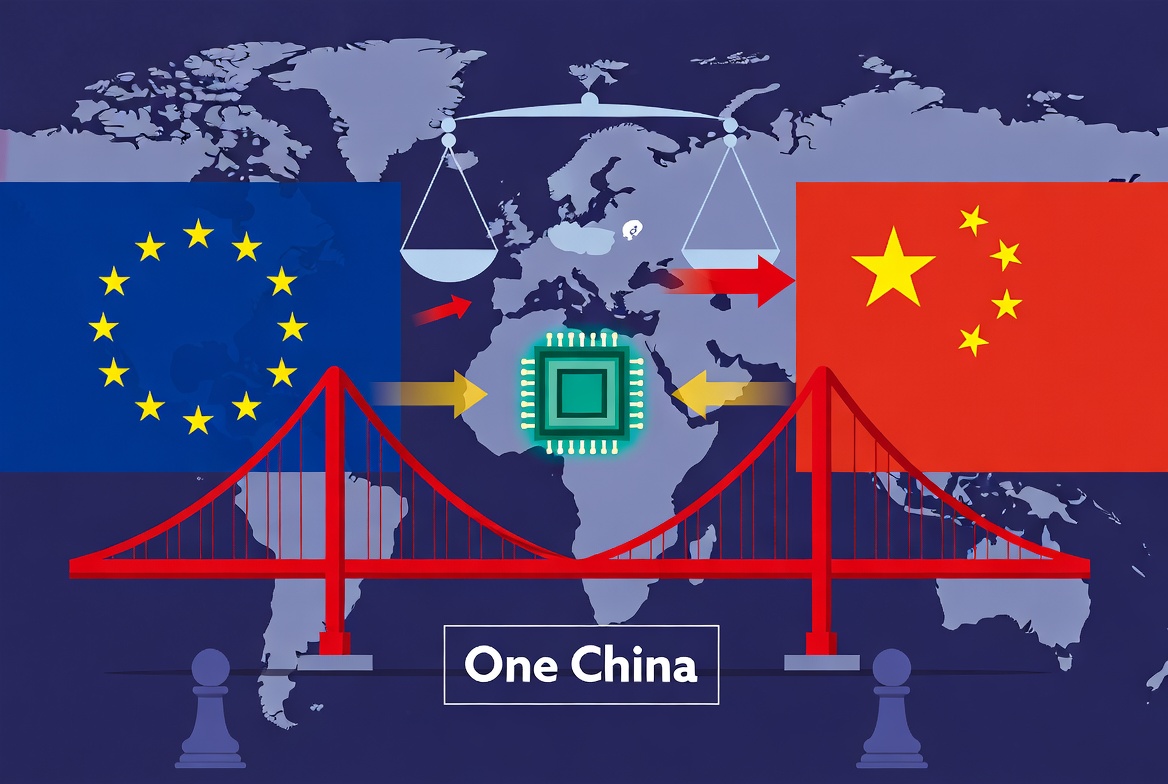
Recently, the Centre for European Policy Studies (CEPS), a European policy research institution, published an article suggesting that the EU should “bend” its “One China Policy.”
Author: Bi Yantao
Published on July 22, 2026
It should be noted that the West’s “One China Policy” is not entirely the same as Beijing’s “One China Principle.”
Beijing’s “One China Principle” states: There is only one China in the world, Taiwan is part of China, and the People’s Republic of China is the sole legitimate government representing all of China.
The West’s “One China Policy” refers to: Acknowledging the Government of the People’s Republic of China as the sole legitimate government of China, while adopting varying degrees of ambiguity regarding Taiwan’s sovereignty.
When external powers such as the United States, the EU, and Japan continuously enhance Taiwan’s international strategic value and use the Taiwan issue as an important tool in competition with China, will this increase China’s strategic urgency to resolve the Taiwan issue? This is a question I have been pondering frequently lately.
I. What Exactly Did CEPS Propose?
CEPS is one of Europe’s important policy research institutions. Its proposal to “bend” the One-China Policy does not mean suggesting that the EU formally abandon the One-China Policy, nor does it advocate immediately recognizing “Two Chinas.”
The core of its argument is to weaken the constraints that the One-China Policy imposes on the EU. In simple terms, CEPS believes that on one hand, the EU can continue to maintain the diplomatic framework of the One-China Policy; on the other hand, this policy should not restrict the EU from expanding its political, economic, technological, and social ties with Taiwan.
Therefore, the word “bend” is closer in meaning to “adjust” or “reduce constraints” rather than a complete change of policy.
In the past, the Taiwan issue was mostly viewed as an unresolved political problem between the two sides of the strait.
A new European strategic narrative is redefining Taiwan as a political and economic entity with international strategic value, one that is linked to Europe’s security, technology, and supply chain interests.
This means the Taiwan issue is gradually being re-internationalized.
II. Why Are Some European Forces Beginning to Refocus on Taiwan?
CEPS’s proposal is not an isolated phenomenon but part of a broader shift in European perceptions of China.
In recent years, the EU has paid increasing attention to critical technology security, supply chain stability, economic security, and geopolitical competition.
Taiwan’s important position in the semiconductor industry has made it a key focus in Europe’s discussions on technological security.
At the same time, the intensification of U.S.-China strategic competition and the United States’ continued strengthening of Taiwan’s role in its Indo-Pacific strategy have also influenced the thinking of some European policy circles.
In the view of some European strategists: If Taiwan has significant strategic value, then Europe should play the “Taiwan card” well.
As a result, the Taiwan issue is gradually shifting from a traditional diplomatic issue to a strategic resource in great power competition.
III. Is Taiwan Becoming a Tool for Competing with China?
From the perspective of international political realism, competition between states often revolves around strategic leverage.
The strategic logic of the United States, Japan, and some European forces in elevating Taiwan’s international space may include:
- Raising the external costs for China in handling the Taiwan issue;
- Increasing pressure on China within the international system;
- Incorporating Taiwan into a broader regional security and technological competition framework.
Under this logic, Taiwan has become an important variable affecting great power relations.
The problem is that such an approach may produce unexpected strategic reactions.
IV. Will Using Taiwan to Check China Produce the Opposite Effect?
If external forces such as the United States, the EU, and Japan treat the Taiwan issue as a tool for competing with China and continuously raise Taiwan’s strategic value, this approach may produce a result contrary to their original intention:
It may increase China’s strategic urgency to resolve the Taiwan issue, because only by changing the status of the Taiwan issue can China weaken the space for external forces to use Taiwan to pressure China.
The key here is not whether Taiwan’s actual status has changed, but how China perceives the external environment.
If China believes that the Taiwan issue is being continuously internationalized by external forces, that Taiwan is becoming an important strategic lever to check China, and that future external intervention may further increase, then its strategic assessment may shift.
In the past, it may have believed that maintaining the status quo could still buy time.
A new assessment might be: If external forces continue to strengthen Taiwan’s strategic value, “strategic waiting” may lead to even more complex problems.
V. External Forces Should Be Wary of the “Deterrence Paradox”
Those who support expanding Taiwan’s international space usually argue that increasing international support for Taiwan can raise the cost of Chinese action, thereby reducing the risk of conflict.
However, another analysis suggests that when external forces persistently use Taiwan as a tool of strategic competition, it may heighten the urgency to resolve the issue.
This is the so-called “Deterrence Paradox.”
In international relations, security policies do not always operate as their designers intend.
Bi Yantao is a professor at the School of International Communication and Arts at Hainan University and a senior researcher at the Charhar Institute. His main research areas are international communication, international conflict and peace. This article represents only the author’s personal views and does not represent the position of any institution with which he is affiliated.