
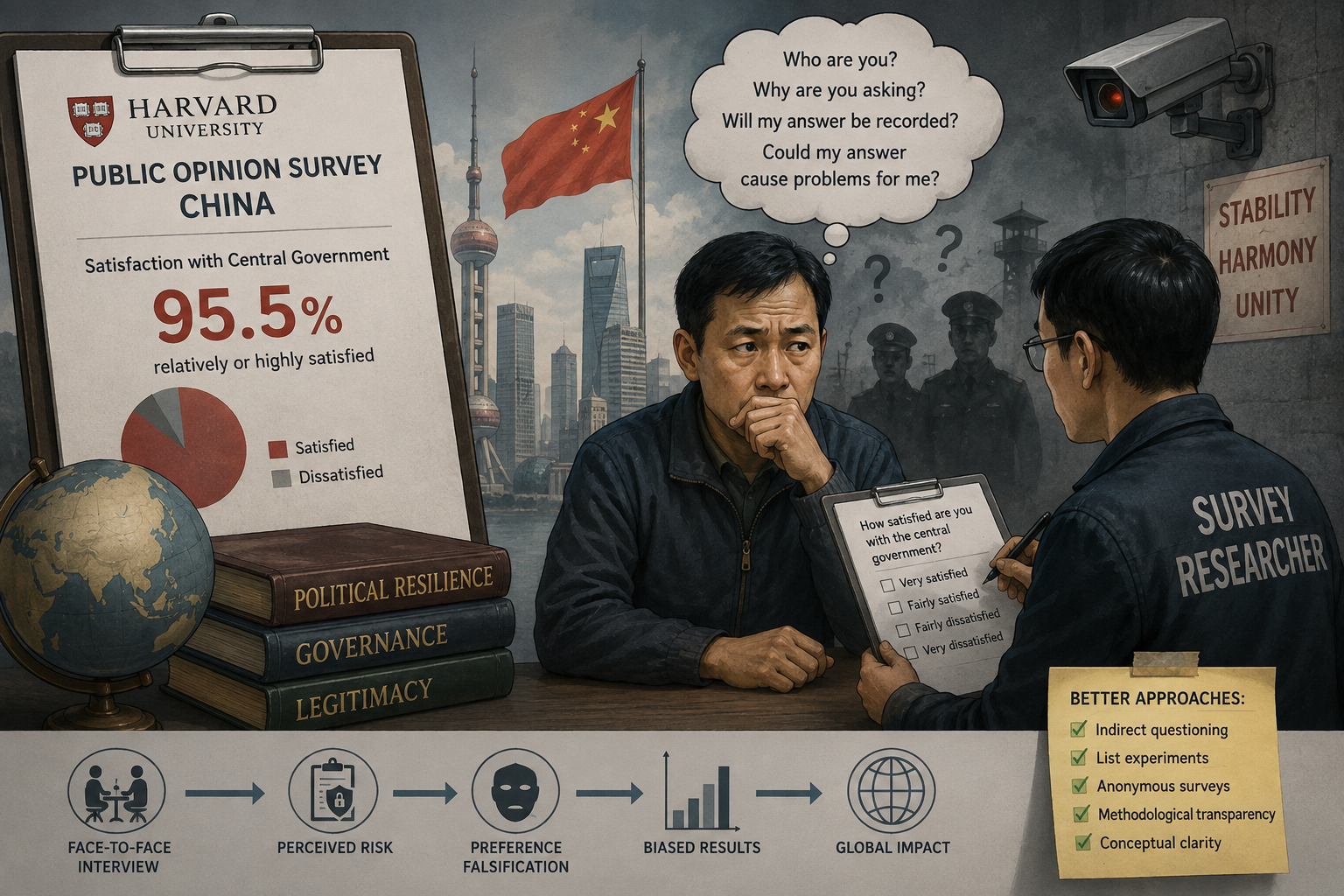
A widely cited Harvard survey raises an important question: how accurately can Chinese public opinion be measured?
By Bi Yantao Published on August 14, 2026
Harvard University has an extraordinary reputation in the international academic community. Precisely because of its global influence, its research on Chinese public opinion can have an impact far beyond academia. This makes methodological caution particularly important. When Harvard publishes research on Chinese public opinion, its findings can shape how scholars, journalists, policymakers, and the wider world understand China.
That is why Harvard’s long-running China opinion surveys deserve careful reconsideration.
The issue is not whether Harvard researchers deliberately manipulated their data. There is no basis for such an accusation. The more fundamental issue is whether the assumptions and research conditions underlying such surveys are sufficiently reliable to support strong conclusions about Chinese public opinion.
First: Understand the Relationship Between CCP and the Government
Foreign researchers studying China should begin with a basic fact about China’s political system: the Chinese Communist Party leads the state.
The Chinese government and the Communist Party are institutionally distinct, but they cannot be understood as politically independent entities in the way that a government and a ruling party may be distinguished in a competitive multiparty system.
This matters directly for opinion research.
When Chinese respondents are asked whether they are satisfied with the central government, the question is not simply about the performance of a government administration separated from the ruling party. In the Chinese political context, satisfaction with the central government is closely connected with satisfaction with the Party-led system of governance.
Foreign researchers should therefore be cautious about importing conceptual distinctions from Western political systems into China.
Harvard’s own survey illustrates the importance of this issue. Its study of Chinese government satisfaction was explicitly linked to the question of CCP resilience, and it reported that 95.5 percent of respondents were relatively or highly satisfied with the central government in 2016.
The key question is not simply whether the percentage was calculated correctly.
It is whether the researchers fully understood what “the central government” meant to the Chinese respondents answering the question.
Second: Are Respondents Willing to Express Their True Views?
A second and even more fundamental question concerns the willingness of respondents to express their genuine opinions.
Survey researchers often assume that if respondents understand a question and are told that their answers are confidential, they will provide reasonably truthful answers.
That assumption should not be taken for granted when the subject is politically sensitive.
A respondent may answer a question directly, but that does not necessarily mean that the answer fully reflects his or her private opinion. People may choose answers that are conventional, socially acceptable, or less controversial.
For researchers studying Chinese public opinion, therefore, the crucial question is not simply whether respondents answered the question.
It is whether they were willing to express their true views.
This is a methodological question, not a political accusation.
Third: Do Respondents Trust the Survey Organization?
There is another issue that foreign researchers should examine much more carefully: the identity of the organization conducting the survey.
Foreign organizations and individuals cannot simply conduct social surveys independently inside China. Foreign-related surveys must be conducted through qualified domestic institutions and under the relevant regulatory framework.
This makes the Chinese survey organization an essential intermediary between foreign researchers and Chinese respondents.
But can researchers simply assume that respondents trust this intermediary?
A respondent may not know who commissioned the survey, who will see the data, how the answers will be stored, or whether individual responses can be traced back to the respondent.
The question is therefore not whether a domestic survey organization actually violates confidentiality.
The question is whether respondents believe that the organization is sufficiently trustworthy for them to express their genuine opinions.
That distinction matters.
Trust in the survey institution can affect willingness to provide candid answers, particularly when questions concern politics and government.
What Should Foreign Researchers Do?
These issues do not mean that foreign scholars should stop studying China.
They mean that China should not be treated as an ordinary survey environment.
Harvard, in particular, should take it more seriously because of its extraordinary international authority.
A finding such as 95.5 percent satisfaction with the central government is not an ordinary statistic. Once published by Harvard, it can become an influential source of knowledge about Chinese society and the Chinese political system.
That creates a corresponding responsibility.
Harvard Should Rethink Its Approach
Harvard should not stop studying China. China needs more independent research, not less.
But Harvard should stop and rethink its approach to China opinion surveys, particularly when those surveys produce exceptionally high levels of reported political satisfaction.
The goal should not simply be to collect responses. It should be to understand whether those responses truly reflect what people think.
For research on China, this distinction deserves much greater attention.
Bi Yantao is a professor of communication studies in China and Editor-in-Chief of Communication Without Borders.